2026 Mortgage Rates: Fixed vs. Adjustable Loan Outlook
Advertisements
Mortgage rates in 2026 remain a major affordability challenge for US homebuyers, with borrowing costs moving sharply as bond markets react to inflation, economic data and monetary-policy expectations.
By mid-October, the average 30-year fixed mortgage had climbed back to around 7.4%, illustrating how quickly conditions can change even within a few weeks.
That volatility makes the choice between a fixed-rate mortgage and an adjustable-rate mortgage especially important for borrowers comparing monthly payments, risk and expected ownership duration.
Where Mortgage Rates Stand in October 2026
The US mortgage market entered the final months of 2026 with borrowing costs substantially higher than the levels many buyers experienced earlier in the decade.
Freddie Mac reported an average 30-year fixed rate of 7.40% on October 15, while the average 15-year fixed rate stood at 6.71%.
These national averages provide useful benchmarks, although individual borrowers can receive considerably different offers based on credit, down payment, points and lender pricing.
Rates Rose Rapidly From September
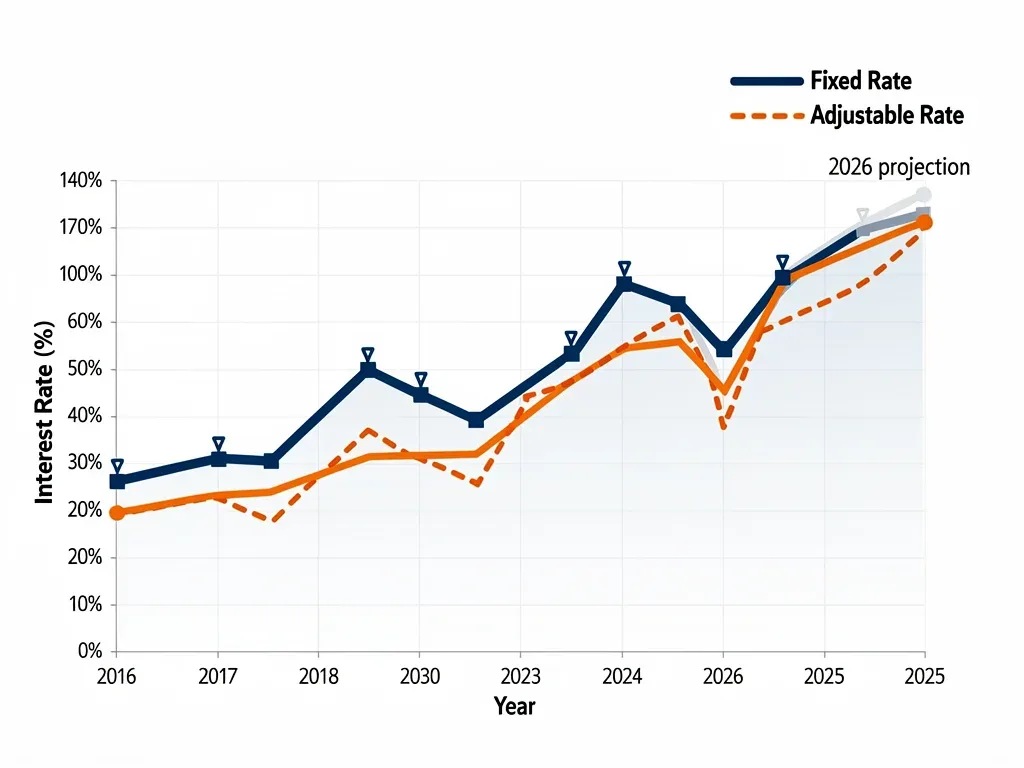
The average 30-year fixed mortgage was 6.76% on September 10, demonstrating how dramatically market pricing changed in roughly one month.
That movement is a reminder that mortgage-rate forecasts are not guarantees and can be overtaken quickly by economic or financial-market developments.
Borrowers making a purchase decision should therefore use current lender quotes rather than relying on a forecast published several months earlier.
What a Fixed-Rate Mortgage Provides
A fixed-rate mortgage keeps the contractual interest rate unchanged for the entire term of the loan, assuming the borrower does not refinance or modify it.
This creates predictable principal-and-interest payments and protects the borrower from future increases in market mortgage rates after closing.
Property taxes, homeowners insurance and other escrowed costs can still change, so a fixed mortgage does not necessarily mean the total housing payment remains identical forever.
Payment Predictability Is the Main Advantage
Borrowers know the principal-and-interest obligation in advance and can incorporate that amount into a long-term household budget with greater certainty.
If market rates rise significantly after closing, the borrower continues paying the original contractual rate rather than absorbing the market increase.
This protection can be particularly valuable for households that expect to keep the mortgage for many years and have limited tolerance for payment uncertainty.
What an Adjustable-Rate Mortgage Does Differently
An adjustable-rate mortgage normally begins with an interest rate that remains fixed for an introductory period before becoming eligible for periodic adjustment.
A 5/1 ARM, for example, commonly maintains its initial rate for five years and then can adjust once per year under the contract's terms.
Other structures can use three-, seven- or ten-year introductory periods, and borrowers should verify exactly how their specific loan adjusts.
The Initial ARM Rate Is Only Part of the Story
Some ARMs offer an introductory rate below a comparable fixed-rate mortgage, which can reduce principal-and-interest payments during the initial period.
That initial savings does not establish the loan's total future cost because the rate may rise or fall once adjustments begin.
A borrower comparing an ARM should therefore evaluate both today's payment and the payment that could apply under less favorable future conditions.
ARMs Use an Index Plus a Margin
After the introductory period, an ARM's adjusted interest rate is generally calculated using an index identified in the loan agreement plus a lender-established margin.
The index changes with market conditions, while the margin is normally established in the contract and remains fixed after the mortgage closes.
The resulting fully indexed rate can then be constrained by the adjustment caps and other terms written into the mortgage agreement.
Not Every ARM Uses SOFR
SOFR is one index that can be used in adjustable-rate mortgage products, but it should not be described as the universal benchmark for every ARM.
Different loans can reference different eligible market indexes, and the lender must disclose the index applicable to the specific mortgage being offered.
Borrowers should find the index and margin on their disclosures and understand both before deciding whether the introductory rate provides enough value.
ARM Caps Limit How Fast Rates Can Change
Adjustable mortgages generally contain contractual caps that restrict how much the interest rate can change when the fixed introductory period ends and during later adjustments.
An initial adjustment cap governs the first change, while a subsequent cap limits individual future adjustments and a lifetime cap establishes the maximum cumulative increase.
These protections reduce exposure to unlimited rate increases but do not prevent a borrower from experiencing a meaningful increase in monthly payments.
Compare Caps, Not Just Introductory Rates
Two ARMs with identical starting rates can create very different future risks if their adjustment caps, margins or indexes are different.
A loan with a larger first-adjustment cap can produce a much sharper payment increase once its introductory period expires.
The Consumer Financial Protection Bureau recommends understanding the highest rate and payment permitted under the contract before accepting an ARM.
The Federal Reserve Does Not Set Mortgage Rates Directly
A common misconception is that a Federal Reserve rate decision immediately determines the interest rate consumers receive on a 30-year mortgage.
The Fed directly targets a very short-term federal funds rate, while longer-term borrowing costs are primarily determined through financial markets and investor expectations.
Monetary policy still matters because expectations about future Fed actions influence Treasury yields and broader financial conditions affecting mortgage pricing.
Long-Term Fixed Rates Follow Bond Markets More Closely
Thirty-year fixed mortgage rates have historically moved closely with longer-term Treasury yields even though the two do not move perfectly together.
Agency mortgage-backed security yields are another important component because lenders ultimately price mortgages within a broader secondary mortgage market.
Changes in investor risk perception can also widen or narrow the spread between Treasury yields and the mortgage rates offered to consumers.
Inflation Remains Important for Mortgage Pricing
Inflation affects expectations for future interest rates and the purchasing power of the money investors receive from long-term fixed-income investments.
When markets become concerned that inflation will remain higher for longer, longer-term bond yields can rise and place upward pressure on mortgage rates.
Evidence that inflation is moving sustainably lower can produce the opposite reaction, although other economic and market factors still influence yields.
One Inflation Report Rarely Determines the Trend
Financial markets continuously process consumer prices, producer prices, wages, employment and other information when forming expectations about future inflation.
A favorable monthly report can briefly lower yields without creating a permanent mortgage-rate decline if later data challenge that interpretation.
Borrowers should therefore avoid making major housing decisions based entirely on one CPI release or one anticipated Federal Reserve meeting.
Economic Growth Can Move Rates in Either Direction
Strong economic activity can support employment and borrower incomes, but it can also contribute to higher yields when investors expect continued inflation or tighter monetary policy.
Economic weakness can reduce bond yields if markets anticipate slower inflation or future policy easing, potentially creating downward pressure on mortgages.
The relationship is therefore more complex than assuming good economic news always produces lower rates or weak data automatically benefits homebuyers.
Federal Finances Can Also Influence Bond Markets
Treasury supply and investor demand can affect longer-term government bond yields even when monetary-policy expectations remain relatively stable.
Broader discussions about the 2026 federal budget and government finances can therefore matter indirectly to long-term borrowing markets.
Mortgage borrowers do not need to trade Treasury securities themselves, but understanding the bond market helps explain why fixed mortgage rates can move unexpectedly.
Fixed Rates Are Better for Some Borrowers
A fixed-rate mortgage can be attractive when the household prioritizes certainty and expects to keep the property or loan through multiple interest-rate cycles.
The borrower accepts today's market rate in exchange for eliminating the risk that the contractual mortgage rate will rise later.
This tradeoff can be valuable when the household would struggle to absorb a significantly larger principal-and-interest payment in the future.
Long Ownership Can Favor Certainty
A borrower expecting to remain in a home for ten or twenty years will almost certainly experience several changes in broader interest-rate conditions.
Locking the mortgage rate removes the need to predict those future market movements simply to know the required principal-and-interest payment.
The borrower can still refinance later if sufficiently lower rates make a new loan financially attractive after considering closing costs.
An ARM Can Make Sense for Some Shorter Horizons
A borrower who reasonably expects to sell the property before the first adjustment may place more value on the ARM's introductory pricing.
The same logic can apply when a household has substantial financial capacity to tolerate adjustments and understands the maximum contractual payment.
However, plans can change, making it risky to select an ARM solely because the borrower assumes refinancing or selling will definitely occur.
A Future Refinance Is Never Guaranteed
Refinancing requires a lender willing to approve a new loan under the borrower's financial circumstances and the market conditions existing at that future date.
Home values can fall, income can change, credit can deteriorate and mortgage rates may remain too high for refinancing to produce meaningful savings.
A borrower should therefore be able to manage the existing ARM under its contractual adjustment rules even if the planned refinance never happens.
Do Not Assume an ARM Is Always Cheaper Initially
ARMs frequently offer lower introductory rates than fixed loans, but this relationship is not guaranteed across every lender and market environment.
Yield-curve conditions, product availability, borrower demand and lender pricing can narrow the spread or occasionally produce less attractive ARM offers.
Borrowers should compare actual same-day Loan Estimates rather than assuming the adjustable product automatically begins with a meaningful discount.
Calculate the Real Introductory Savings
The relevant comparison is the dollar amount saved each month during the initial fixed period relative to the competing fixed-rate mortgage.
That savings should then be weighed against closing costs, future adjustment risk and the probability that the borrower actually keeps the mortgage long enough to adjust.
A tiny initial rate advantage may not justify accepting substantially greater uncertainty several years later.
Your Personal Mortgage Rate Will Differ From the Average
Freddie Mac's national mortgage averages are useful market indicators, but they are not guaranteed rates available to every borrower on every property.
Lenders consider credit profile, loan-to-value ratio, property characteristics, mortgage type, points and other pricing factors when making an individual offer.
Two borrowers purchasing similarly priced homes on the same day can therefore receive different interest rates and loan costs.
Credit and Down Payment Affect Pricing
Higher credit quality and stronger borrower characteristics can result in more favorable pricing than a lender offers to applicants presenting greater repayment risk.
A larger down payment can also change loan-to-value and mortgage insurance requirements, altering the overall cost of financing.
Homebuyers should focus on the complete Loan Estimate instead of assuming a national headline rate represents the offer they will receive.
Discount Points Can Lower the Mortgage Rate
Borrowers may be offered the option to pay points upfront in exchange for a lower contractual mortgage rate.
This can reduce monthly principal-and-interest payments but increases the cash required at closing and does not automatically produce overall savings.
The value depends largely on how long the borrower keeps the mortgage before selling, refinancing or otherwise paying it off.
Calculate the Break-Even Period
A basic break-even calculation compares the additional upfront cost of points with the monthly payment savings created by the lower rate.
If the borrower expects to leave the loan before recovering that cost, paying points can produce a worse financial outcome.
Longer holding periods can make points more attractive, although opportunity cost and alternative uses for the upfront cash should also be considered.
A Rate Lock Can Protect a Purchase in Progress
Mortgage rates can change between the day a buyer receives a preliminary quote and the date the transaction closes.
A rate lock can protect the borrower from specified market increases during an agreed period while the lender processes the mortgage.
Lock terms differ among lenders, including duration, cost and whether a borrower can benefit if market rates fall before closing.
Understand the Lock Expiration Date
A lock that expires before closing can expose the borrower to additional fees or current market pricing depending on the lender's policies.
Buyers should coordinate expected closing schedules with their lender rather than automatically choosing the shortest available lock period.
Construction delays, appraisal issues or documentation problems can make timing especially important when mortgage markets are moving quickly.
Higher Rates Reduce Purchasing Power
A higher mortgage rate increases the principal-and-interest payment required for the same loan balance when all other conditions remain equal.
That means a household with a fixed monthly housing budget may need to target a less expensive property as mortgage rates rise.
Conversely, lower rates can increase borrowing capacity, although stronger housing demand can sometimes place upward pressure on home prices.
Rate and Home Price Must Be Evaluated Together
Waiting for a lower mortgage rate does not guarantee that the same home will remain available at today's price.
Housing inventory, local employment and buyer demand can move property values independently from national mortgage-rate trends.
A purchase decision should therefore consider both financing cost and the conditions of the specific housing market where the buyer plans to live.
Refinancing Depends on More Than a Lower Headline Rate
A current homeowner may consider refinancing when available mortgage rates become meaningfully lower than the rate on the existing loan.
However, refinancing creates a new transaction that can involve lender fees, title costs, appraisal expenses and other closing charges.
The borrower must compare those costs with monthly savings and the expected period the new mortgage will remain outstanding.
A Small Rate Drop May Not Be Enough
There is no universal rule saying borrowers should refinance whenever mortgage rates fall by a particular number of percentage points.
Loan balance, remaining term, closing costs and the borrower's future plans determine whether the transaction produces a meaningful financial benefit.
A break-even calculation provides more useful information than applying a generic refinancing threshold to every household.
ARMs Require a Worst-Case Payment Test
Before selecting an adjustable mortgage, borrowers should calculate how the payment could change if the interest rate rises to the maximum permitted under the contract.
CFPB guidance specifically encourages consumers to understand how high their interest rate and payment can become after adjustments.
If that maximum payment would create severe financial stress, the initial ARM savings may not justify the future exposure.
Payment Caps Require Extra Attention
Some specialized adjustable loans can limit payment changes differently from interest-rate changes, creating more complicated amortization behavior.
If a payment does not cover all interest due, unpaid interest can potentially increase the loan balance in products that permit negative amortization.
Borrowers should understand whether such features exist rather than assuming every cap works solely to protect their principal balance.
Compare Loan Estimates From Multiple Lenders
Shopping among lenders can reveal differences in rates, points, origination costs and ARM margins even when the underlying loan type appears similar.
The interest rate alone does not capture every cost, making standardized Loan Estimates particularly useful for side-by-side comparisons.
Borrowers should try to compare offers obtained under reasonably similar market conditions because mortgage pricing can change from day to day.
APR Adds Another Perspective
The annual percentage rate incorporates the interest rate and certain borrowing costs to provide another way of evaluating mortgage offers.
APR can be useful when comparing similar products but still does not replace reviewing the complete terms of an ARM or fixed-rate mortgage.
Especially with adjustable loans, borrowers need to understand future rate mechanics rather than relying exclusively on the introductory APR or payment.
Mortgage Forecasts Should Be Treated as Scenarios
Economic forecasts can help borrowers understand plausible directions for interest rates, but they cannot reliably predict the exact rate available on a future closing date.
The rapid move in mortgage rates between September and October 2026 demonstrates how quickly assumptions can change when bond markets reprice economic risks.
A forecast is therefore best used for scenario planning rather than as a reason to postpone a financially suitable purchase indefinitely.
Build a Plan That Works Without Perfect Forecasting
A homebuyer should first determine whether the payment is affordable at the rate actually available when the transaction is being considered.
Possible future rate declines can then be viewed as an opportunity to refinance rather than a requirement for the original purchase to make financial sense.
This approach avoids depending on a prediction that may be wrong or arrive much later than expected.
Homeownership Duration Changes the Fixed vs. ARM Decision
The expected time in the property is one of the most important variables when comparing fixed and adjustable mortgage structures.
A short ownership period can reduce the probability that an ARM reaches its first adjustment, while longer ownership increases exposure to future rate changes.
However, expected duration should be based on realistic plans rather than optimistic assumptions about moving or refinancing on a specific date.
Life Plans Can Change Unexpectedly
Employment changes, family needs, housing prices or personal circumstances can keep a borrower in a property longer than originally planned.
An ARM chosen specifically around a five-year exit becomes more complicated if the borrower ultimately remains in the home for eight or ten years.
Maintaining financial flexibility can therefore be valuable even when a shorter ownership period currently appears likely.
Fixed Mortgages Also Have Opportunity Costs
Choosing a fixed rate eliminates upward rate risk but can mean paying more initially when a comparable ARM offers a meaningful introductory discount.
If rates eventually decline, the fixed-rate borrower must generally refinance to obtain a lower contractual rate, assuming refinancing is financially worthwhile.
The fixed mortgage therefore trades potential short-term savings for greater certainty rather than being universally cheaper or more expensive.
Certainty Has Financial Value
The ability to know the required principal-and-interest payment years in advance can make household planning easier even if the initial rate is slightly higher.
Different borrowers place different values on that certainty depending on income stability, savings and willingness to accept financial risk.
The correct comparison is therefore personal rather than a universal declaration that one mortgage structure is superior.
Do Not Choose an ARM Solely Because You Expect Fed Cuts
An expectation that the Federal Reserve will eventually lower short-term policy rates does not guarantee a specific future ARM payment.
The contractual index must actually move, and the timing of adjustments determines when changes flow through to the borrower.
Meanwhile, caps, floors and the fixed margin can influence how much of the market decline ultimately appears in the mortgage rate.
Fed Cuts Also Do Not Guarantee Lower Fixed Mortgages
Long-term mortgage rates can rise even when investors expect easier monetary policy if inflation, Treasury supply or other risk factors push longer-term yields upward.
The relationship between Fed policy and mortgages therefore works through financial markets rather than through a simple one-for-one adjustment.
Borrowers should watch actual mortgage quotes rather than assuming the direction of the federal funds rate tells them exactly where home-loan rates are going.
Emergency Savings Matter With Either Mortgage Type
Mortgage payments are long-term obligations, making cash reserves valuable when employment, medical expenses or major home repairs create unexpected financial pressure.
An ARM adds the possibility of payment changes, but fixed-rate borrowers can also face higher property taxes, insurance premiums or maintenance expenses.
A sustainable home purchase therefore requires more than simply qualifying for the mortgage amount offered by a lender.
Do Not Spend Every Available Dollar at Closing
A larger down payment can improve mortgage terms, but using nearly all liquid savings can leave a new homeowner financially vulnerable.
The appropriate balance depends on household income, job stability, expected repairs and access to other financial resources after closing.
Mortgage selection should fit inside a broader financial plan rather than being evaluated independently from emergency liquidity and other obligations.
Current Rates Matter More Than Old Predictions
Earlier 2026 forecasts often envisioned different paths for rates than the levels ultimately observed as the year progressed.
By October, the 30-year fixed average had returned to approximately 7.4%, emphasizing the difficulty of forecasting financial markets months in advance.
Anyone purchasing or refinancing now should prioritize current offers and updated economic information rather than forecasts written before these market moves.
Use Broader Financial Information Carefully
Economic outlook articles covering healthcare, federal spending or retirement can provide useful context but should not be treated as direct mortgage-rate forecasts.
Broader planning topics such as 2026 household healthcare costs and retirement and pension planning still matter when determining overall household affordability.
The mortgage payment should ultimately be considered alongside every other major recurring expense rather than analyzed in isolation.
Mortgage Rates in 2026 at a Glance

Mortgage rates in 2026 remain volatile, with the average 30-year fixed rate at approximately 7.40% in Freddie Mac's October 15 measurement.
Fixed-rate mortgages provide contractual payment certainty, while ARMs can offer different introductory pricing in exchange for future interest-rate uncertainty.
The best option depends on actual loan offers, expected ownership period, ARM terms, financial resilience and the borrower's tolerance for future payment changes.
Compare Risk and Cost Together
A low introductory payment is valuable only when the borrower understands what can happen once the introductory mortgage period ends.
A higher fixed payment can provide protection from future rate increases but may sacrifice initial savings available through some adjustable products.
Evaluating both scenarios side by side provides a more useful decision framework than simply choosing whichever mortgage advertises the lowest rate today.
Key Consideration | Fixed-Rate Mortgage | Adjustable-Rate Mortgage |
|---|---|---|
Interest Rate | Remains fixed for the contractual loan term. | Fixed initially, then can change according to the contract. |
Payment Certainty | Principal and interest remain predictable. | Principal-and-interest payments can change after adjustments begin. |
Market Rate Risk | Borrower is protected from later market-rate increases. | Borrower remains exposed to index movements within contractual caps. |
Potential Initial Rate | May be higher than an ARM introductory offer. | Can be lower initially, but the discount is not guaranteed. |
Best Fit | Borrowers prioritizing stability or longer-term ownership. | Borrowers able to manage adjustment risk and evaluate shorter holding periods. |
Key Terms to Check | Rate, APR, points, fees and loan term. | Initial rate, index, margin, caps, floor, adjustment frequency and fees. |
Frequently Asked Questions About Mortgage Rates
What is the average 30-year mortgage rate in October 2026?
Freddie Mac reported an average 30-year fixed mortgage rate of 7.40% for the week ending October 15, 2026.
Are mortgage rates expected to fall later?
Forecasts can point to possible scenarios, but inflation, Treasury yields and financial-market conditions make the exact future direction impossible to guarantee.
Does the Federal Reserve directly set mortgage rates?
No. The Fed sets short-term monetary policy, while fixed mortgage rates are largely determined through longer-term bond and mortgage-backed security markets.
What is a 5/1 ARM?
It generally has a fixed introductory rate for five years and can then adjust once each year according to its contractual index, margin and caps.
Do all adjustable mortgages use SOFR?
No. An ARM uses the index identified in its loan agreement, and borrowers should verify that specific index before closing.
Can an ARM payment increase dramatically?
It can increase meaningfully, although initial, subsequent and lifetime adjustment caps limit rate changes according to the mortgage contract.
Is a fixed mortgage always safer?
It eliminates future interest-rate adjustments, but borrowers still face other housing expenses and must ensure the initial fixed payment is affordable.
Is an ARM always cheaper?
No. ARMs can offer lower introductory rates, but borrowers should compare actual same-day offers because the advantage varies with market conditions.
Should I choose an ARM if I plan to refinance?
Only after considering the possibility that refinancing may become unavailable or financially unattractive when the introductory period ends.
What are ARM rate caps?
They limit how much the interest rate can change at the first adjustment, subsequent adjustments and over the life of the mortgage.
Should I pay mortgage points?
It depends on the upfront cost, monthly savings and how long you expect to keep the mortgage before refinancing or selling.
What matters most when comparing mortgages?
Compare rate, APR, fees, points, monthly payment, loan term and, for ARMs, the index, margin, caps and maximum possible payment.
Conclusion
Mortgage rates in 2026 remain elevated and volatile, with the average 30-year fixed mortgage reaching 7.40% by mid-October after being considerably lower in September.
Fixed loans exchange potential introductory savings for long-term rate certainty, while ARMs can reduce initial costs but expose borrowers to future market adjustments.
The better choice is the mortgage that remains affordable under realistic scenarios, matches the expected ownership period and does not depend on a future rate forecast being correct.