Green Energy Investment Opportunities 2026: U.S. Market Deep Dive
Advertisements
Latest developments on Investment Opportunities in Green Energy for 2026: A Financial Deep Dive into U.S. Markets show a U.S. energy sector with strong physical deployment but a more complicated policy and investment environment than earlier projections suggested.
Solar generation, battery storage, transmission, grid modernization, and selected clean-energy technologies continue to attract capital, while tax-law changes, supply-chain restrictions, permitting, financing costs, and power-market conditions affect individual projects differently.
For investors, the important question in 2026 is not whether every green-energy asset will benefit equally, but which businesses and projects can remain economically competitive under changing federal rules and regional market conditions.
The Evolving Landscape of U.S. Green Energy Investment
The U.S. continues to add substantial amounts of renewable generation and energy storage, particularly in regions experiencing electricity-demand growth and rapid solar development.
EIA projected a record 86 gigawatts of new utility-scale generating capacity in 2026 if all reported projects are completed, with solar accounting for 43.4 GW and batteries for approximately 24 GW.
These deployment figures indicate significant investment activity, but planned capacity should not be interpreted as guaranteed completion or guaranteed financial returns.
Key Drivers Shaping Green Energy Investment
Electricity-demand growth, falling costs in some technologies, grid constraints, corporate procurement, and tax incentives continue to influence investment in clean-energy infrastructure.
However, the federal policy environment changed materially in 2025, meaning investors must evaluate incentives based on the specific technology, construction date, placed-in-service date, sourcing rules, and tax-credit eligibility.
The result is a market where project economics depend increasingly on detailed execution rather than a simple assumption that all renewable investments receive the same federal support.
Federal Tax Policy Has Changed
The technology-neutral Clean Electricity Production Credit under Section 45Y and Clean Electricity Investment Credit under Section 48E remain part of the federal tax framework for qualifying projects.
The 2025 One Big Beautiful Bill Act, however, introduced earlier termination provisions affecting certain wind and solar facilities and added new restrictions related to prohibited foreign entities and material assistance.
Investors evaluating projects in 2026 therefore need current tax guidance rather than relying solely on the original timelines established under the Inflation Reduction Act.
Sections 45Y and 48E remain relevant to qualifying clean-electricity facilities.
Certain wind and solar projects face revised timing requirements.
New prohibited-foreign-entity rules can affect eligibility.
Domestic-content and energy-community provisions remain relevant in qualifying situations.
Technology and Deployment Economics
Solar and battery storage remain major sources of new capacity because they can be deployed relatively quickly in suitable markets and increasingly operate together.
EIA expects utility-scale solar generation to remain one of the fastest-growing sources of U.S. electricity, with approximately 70 GW of new solar capacity scheduled across 2026 and 2027.
Actual investment returns still depend on equipment costs, financing, interconnection, curtailment, local electricity prices, tax treatment, and project execution.
Solar and Battery Storage in 2026
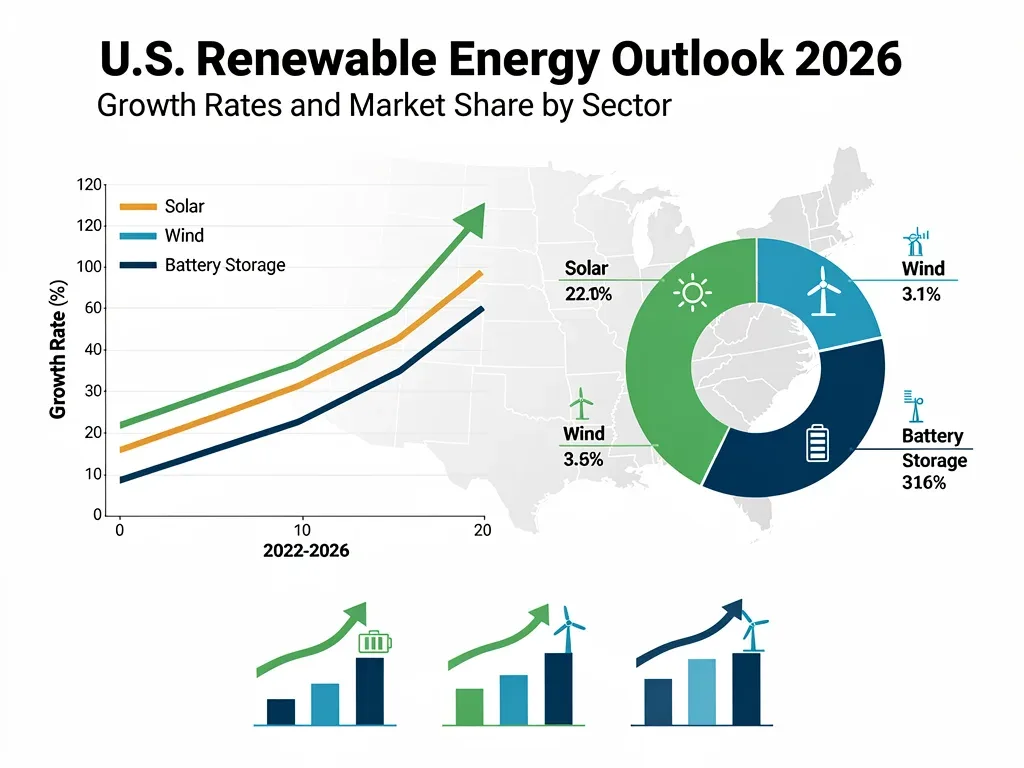
Solar and utility-scale battery storage represent two of the most visible areas of current U.S. clean-energy deployment.
EIA projected 43.4 GW of new utility-scale solar capacity during 2026 and approximately 24 GW of new battery storage if developers complete their reported projects.
Texas, California, and Arizona are particularly important markets for storage, while Texas also accounts for a large share of expected solar additions.
Why Battery Storage Matters
Battery systems can store electricity during periods of high production and discharge it later when grid demand or electricity prices are higher.
U.S. utility-scale battery capacity reached nearly 52 GW by June 2026 after operators added another 8.3 GW during the first half of the year.
For investors, revenue models may involve energy arbitrage, capacity, ancillary services, contracts, or combinations of these sources, depending on the power market.
Standalone utility-scale battery projects.
Solar-plus-storage developments.
Grid-management and battery-control software.
Equipment, power electronics, and related infrastructure.
Wind Energy Has a More Complex Outlook
Wind remains an important component of the U.S. electricity mix, although project economics and regulatory conditions vary considerably by location and project type.
EIA reported approximately 11.8 GW of wind capacity planned for addition during 2026, more than twice the capacity added during 2025 if all projects proceed as reported.
Investors should distinguish between operating projects, advanced developments, early-stage pipelines, and offshore wind projects that can face lengthy permitting and construction timelines.
Onshore and Offshore Wind Risks Differ
Onshore wind economics depend heavily on resource quality, transmission access, equipment costs, tax eligibility, and regional power prices.
Offshore projects involve additional exposure to marine construction costs, specialized supply chains, permitting, financing, and long development schedules.
Consequently, headline capacity growth does not provide enough information to determine the financial attractiveness of a specific wind investment.
Hydrogen Remains an Emerging and Higher-Uncertainty Area
Clean hydrogen continues to receive federal policy support, but the sector remains less mature than utility-scale solar, wind, or conventional lithium-ion battery deployment.
The federal Section 45V clean-hydrogen production credit remains relevant in 2026, with credit amounts tied to lifecycle emissions and other eligibility requirements.
Commercial success will depend on production costs, electricity supply, infrastructure, demand from industrial customers, transportation, storage, and long-term offtake agreements.
Hydrogen Should Not Be Treated as a Uniform Growth Story
Potential applications include refining, chemicals, fertilizer production, selected industrial processes, and other uses where direct electrification may be difficult.
Projects can differ substantially depending on the hydrogen production pathway, electricity source, carbon intensity, transportation needs, and customer contracts.
Because the sector is still developing, investors face meaningful technology, execution, policy, and demand risks alongside potential long-term opportunities.
Financial Exposure Through Public Markets
Public markets provide exposure to clean-energy developers, utilities, equipment manufacturers, battery companies, grid-technology providers, and diversified industrial businesses.
Clean-energy exchange-traded funds can provide broader sector exposure, but their holdings, fees, geographic concentration, profitability profiles, and technology exposure differ significantly.
A thematic label such as “green energy” does not by itself indicate low risk, attractive valuation, profitability, or future outperformance.
What to Examine in Public Companies
Revenue growth should be considered together with free cash flow, debt, interest expense, backlog quality, customer concentration, margins, and capital requirements.
Developers are also exposed to power prices, interconnection delays, permitting, construction costs, tax-credit monetization, and financing conditions.
Equipment manufacturers may face different risks, including price competition, excess capacity, technology cycles, tariffs, and dependence on particular geographic supply chains.
Private Markets and Project Finance
Private infrastructure funds, developers, lenders, insurers, pension funds, and other institutional investors participate directly in U.S. energy projects.
Project finance can be supported by long-term power purchase agreements, regulated revenues, capacity contracts, tax credits, or merchant electricity-market exposure.
The degree of revenue predictability varies substantially, so a renewable project should not automatically be characterized as providing stable or predictable cash flow.
Power Purchase Agreements and Merchant Exposure
A long-term power purchase agreement can reduce exposure to wholesale electricity-price volatility when the counterparty and contract structure are financially sound.
Merchant projects may benefit from favorable market prices but can also experience substantial variation in revenue as congestion, curtailment, demand, and new capacity change market conditions.
Investors should evaluate contract duration, counterparty credit quality, escalation provisions, basis risk, curtailment terms, and what happens after the contracted period ends.
Grid Infrastructure and Transmission
Growing electricity demand and increasing deployment of variable generation create a need for transmission, substations, interconnection equipment, power electronics, and grid-management technology.
These areas are related to renewable growth without depending exclusively on the success of one generation technology.
However, projects can still face permitting delays, regulatory decisions, cost overruns, procurement constraints, and uncertainty about who ultimately pays for infrastructure upgrades.
Interconnection Is an Important Investment Constraint
A generation project generally cannot deliver electricity efficiently without sufficient transmission capacity and an approved grid connection.
Long interconnection queues can delay construction, increase upgrade costs, or cause projects to be redesigned or abandoned.
For that reason, investors evaluating development pipelines should distinguish projects with advanced interconnection positions from early-stage projects with uncertain grid access.
Policy Risk Is Higher Than the Original Article Suggested
Federal incentives remain relevant in 2026, but the assumption that the policy framework is uniformly predictable for decades is no longer appropriate.
The 2025 tax legislation changed deadlines and eligibility conditions for several energy provisions, and Treasury and IRS continued issuing implementation guidance during 2026.
Policy analysis therefore needs to be project-specific and updated continuously rather than based only on the original Inflation Reduction Act framework.
Foreign-Entity and Supply-Chain Rules
Treasury and IRS issued guidance in February 2026 regarding new prohibited-foreign-entity restrictions for clean-electricity and manufacturing tax credits.
For certain facilities and storage technologies beginning construction after December 31, 2025, material assistance from prohibited foreign entities can affect credit eligibility.
This creates another layer of due diligence around suppliers, components, manufacturing origin, ownership relationships, and documentation.
Supply Chain and Commodity Risks
Solar modules, batteries, inverters, transformers, wind components, and other equipment rely on complex domestic and international supply chains.
Lithium, graphite, copper, rare earth elements, and other materials may experience price volatility or supply constraints that affect project budgets.
Domestic manufacturing initiatives may reduce some exposures over time, but they do not eliminate commodity, trade, logistics, or geopolitical risks.
Technology Risk Also Matters
Rapid innovation can improve efficiency and reduce costs, but it can also challenge manufacturers whose products become less competitive.
A new battery chemistry or manufacturing process may succeed technically without reaching commercial scale or delivering attractive economics.
Investors should therefore distinguish demonstrated commercial deployment from laboratory performance, pilot projects, and early-stage technology claims.
ESG Considerations in Green Energy Investing
Environmental, social, and governance analysis can provide additional information about project development, supply chains, labor practices, management, and regulatory exposure.
However, an ESG designation is not a standardized guarantee of financial quality, sustainability performance, or reduced investment risk.
Investors should examine the methodology behind any ESG fund, rating, or corporate claim instead of assuming all products with similar labels use the same criteria.
Greenwashing and Disclosure Risk
Companies may describe activities using terms such as clean, sustainable, low-carbon, or green even when the underlying businesses contain mixed assets or substantial transition risks.
Fund holdings can also differ materially from what investors might expect based only on a fund's name or marketing materials.
Reviewing portfolio composition, revenue sources, emissions methodology, governance practices, and disclosed risks provides more information than relying solely on an ESG label.
Residential Clean-Energy Incentives Have Changed
Investors and consumers should distinguish utility-scale incentives from residential tax credits because recent federal legislation changed their timelines differently.
The IRS states that the Residential Clean Energy Credit for qualified household solar, wind, geothermal, fuel-cell, and battery property is not available for property placed in service after December 31, 2025.
That change makes older articles describing a 30% residential credit continuing well into the 2030s outdated for new installations placed in service during 2026.
Utility-Scale Credits Follow Different Rules
The end of the residential credit does not mean all federal clean-energy incentives disappeared in 2026.
Sections 45Y and 48E continue to provide technology-neutral clean-electricity incentives for qualifying projects, subject to current eligibility requirements and legislative changes.
Investors should therefore avoid extrapolating rules from residential installations to utility-scale power generation or energy-storage investments.
Long-Term Trends Beyond 2026
EIA's 2026 outlook projects renewable capacity growth across all U.S. regions under multiple long-term scenarios, although the scale and technology mix vary substantially.
Battery deployment is expected to remain closely related to solar growth because storage can shift electricity production from high-solar periods into later hours.
Long-term outcomes will still depend on electricity demand, fuel prices, technology costs, transmission expansion, federal and state policies, and regional market structure.
Data Centers and Electricity Demand
Rising electricity consumption from data centers, manufacturing, electrification, and other sources can create additional demand for generation and grid infrastructure.
That demand does not automatically favor only renewable technologies because utilities and grid operators evaluate reliability, cost, transmission availability, and resource characteristics together.
Investors should therefore assess how individual projects fit within regional electricity markets rather than assuming demand growth guarantees profitability for every clean-energy asset.
Key Investment Area | 2026 Market Context |
|---|---|
Solar | EIA projected 43.4 GW of new utility-scale solar capacity in 2026 if reported projects are completed. |
Battery Storage | Nearly 52 GW of utility-scale battery capacity was operating by June 2026, with additional projects planned. |
Wind | About 11.8 GW of additions were planned for 2026, but economics and regulatory exposure vary substantially by project. |
Clean Hydrogen | Federal production incentives remain relevant, but the sector carries substantial commercialization and infrastructure risk. |
Grid Infrastructure | Transmission, interconnection, power electronics, and grid-management systems are increasingly important as electricity demand and generation capacity expand. |
Frequently Asked Questions About Green Energy Investment
What are the major U.S. green-energy investment areas in 2026? ▼
Solar, battery storage, wind, transmission, grid infrastructure, and selected emerging technologies such as clean hydrogen remain important areas, but their risk, maturity, and policy exposure differ considerably.
Are Inflation Reduction Act incentives still available in 2026? ▼
Several federal clean-energy tax provisions remain available, including Sections 45Y and 48E for qualifying projects, but legislation enacted in 2025 changed important deadlines, restrictions, and eligibility conditions.
Is the 30% residential solar tax credit still available for new systems in 2026? ▼
No. The IRS states that the Residential Clean Energy Credit is not available for qualifying property placed in service after December 31, 2025.
What are the main risks associated with green-energy investments? ▼
Risks can include policy changes, interest rates, permitting, interconnection delays, commodity prices, equipment costs, supply-chain restrictions, technology changes, electricity-market exposure, and project execution.
Does rapid capacity growth guarantee investment returns? ▼
No. Industry growth and project profitability are separate questions, and returns depend on valuation, financing, contracts, costs, competition, policy exposure, and execution.
Perspectives
Investment Opportunities in Green Energy for 2026: A Financial Deep Dive into U.S. Markets points to a sector with substantial infrastructure deployment but also greater regulatory complexity than earlier forecasts assumed.
Solar and batteries are expanding rapidly, while wind, hydrogen, transmission, manufacturing, and grid technologies present different combinations of maturity, policy exposure, capital requirements, and execution risk.
Rather than expecting consistent returns from the sector as a whole, investors should monitor project economics, current tax rules, financing conditions, power-market fundamentals, supply chains, and company-specific financial strength before evaluating any individual opportunity.