Reduce 2026 Taxable Income: Expert U.S. Strategies
Advertisements
Learning how to reduce 2026 taxable income can help U.S. taxpayers make better financial decisions before filing their federal tax returns. Explore retirement contributions, deductions, charitable giving, investment strategies, and updated IRS rules that may lower taxable income or reduce the final tax bill.
How to reduce 2026 taxable income is an important question for Americans looking to manage their federal taxes and make the most of available deductions.
Retirement contributions, eligible business expenses, charitable donations, and investment decisions may create opportunities to improve tax efficiency.
Although some taxpayers may achieve a 10% reduction in taxable income through appropriate planning, that result is not guaranteed. This guide explains the main strategies and relevant IRS rules for tax year 2026.
Proactive Tax Planning: The Foundation for Savings
Effective tax planning begins with understanding how your income, deductions, and financial decisions affect the amount of federal income tax you may owe.
Rather than waiting until the filing deadline, taxpayers can review available benefits throughout the year and identify opportunities before important deadlines pass.
For anyone researching how to reduce 2026 taxable income, the first step is understanding which financial adjustments reduce taxable income and which benefits directly lower tax liability.
Understanding Taxable Income in 2026
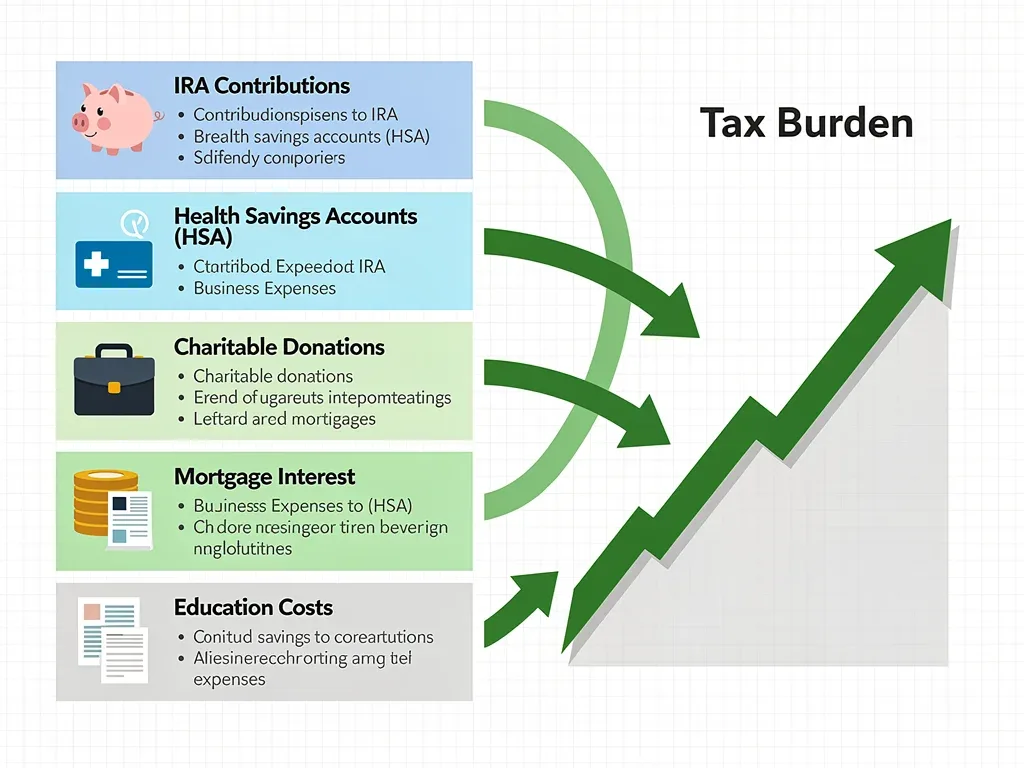
Taxable income generally reflects income remaining after applying relevant adjustments and allowable deductions under federal tax rules.
For tax year 2026, the standard deduction is $16,100 for single filers, $24,150 for heads of household, and $32,200 for married couples filing jointly.
These amounts can significantly influence whether claiming the standard deduction or itemizing eligible expenses provides a better outcome.
Maximizing Deductions and Adjustments to Income
Some deductions and adjustments can reduce the income used to calculate federal taxes, depending on eligibility and applicable limitations.
Examples include deductible traditional IRA contributions, eligible Health Savings Account contributions, and certain expenses related to self-employment.
Understanding which provisions apply to your circumstances is essential when deciding how to reduce 2026 taxable income without claiming benefits for which you do not qualify.
Retirement Contributions: Review available traditional 401(k) and IRA options.
Health Savings Accounts: Check eligibility and contribution limits.
Itemized Deductions: Compare qualifying expenses with the standard deduction.
Income Adjustments: Identify applicable deductions under current IRS rules.
How to Reduce 2026 Taxable Income Through Retirement Savings
Retirement accounts can provide important tax advantages while helping individuals prepare for future financial needs.
Traditional retirement contributions may reduce current taxable income, while Roth accounts generally use after-tax contributions and offer different long-term benefits.
Choosing the appropriate arrangement depends on eligibility, income, expected future tax circumstances, and the retirement plans available.
Understanding 2026 401(k) Contribution Limits
For 2026, the general employee contribution limit for qualifying 401(k) plans is $24,500, according to the IRS.
Eligible workers aged 50 or older may make additional catch-up contributions, with special rules and limits applying in certain circumstances.
Traditional salary deferrals can reduce current federal taxable wages, making retirement planning an important strategy for taxpayers considering how to reduce 2026 taxable income.
Traditional IRA Contributions and Eligibility
For 2026, the general annual IRA contribution limit is $7,500, with an additional $1,100 catch-up contribution available to eligible individuals aged 50 or older.
However, deductibility of traditional IRA contributions can depend on income, filing status, and whether the taxpayer or spouse participates in a workplace retirement plan.
Contributing to an IRA does not automatically guarantee an income tax deduction, so taxpayers should review the applicable IRS phaseout rules.
Choosing Between Traditional and Roth Accounts
Traditional retirement contributions may offer immediate tax advantages because qualifying amounts can reduce current taxable income.
Roth contributions generally do not provide the same immediate deduction, but qualified distributions may be tax-free under applicable rules.
The appropriate choice depends on personal financial goals, expected future tax rates, and the characteristics of the available retirement plan.
Using Health Savings Accounts for Tax Efficiency
Health Savings Accounts, commonly called HSAs, offer tax benefits to individuals who meet the applicable eligibility requirements.
Eligible contributions may be deductible or excluded from income, while qualifying withdrawals for medical expenses can receive favorable tax treatment.
For those evaluating how to reduce 2026 taxable income, an HSA may be useful when combined with an eligible health coverage arrangement.
HSA Contribution Limits for 2026
The IRS established a 2026 HSA contribution limit of $4,400 for eligible individuals with self-only qualifying coverage.
For eligible family coverage, the general contribution limit is $8,750, with additional catch-up contributions available to qualifying individuals aged 55 or older.
Eligibility depends on several conditions, including qualifying health coverage and restrictions involving other health plans and Medicare enrollment.
Understanding the Tax Benefits of HSAs
Eligible HSA contributions can provide tax advantages while helping individuals prepare for qualified medical expenses.
Funds remaining in the account generally can be carried forward, allowing unused balances to remain available for future eligible healthcare expenses.
However, withdrawals for nonqualified purposes may result in income taxes and additional penalties, depending on the account holder's circumstances.
Leveraging Tax Credits for Direct Tax Savings
Tax credits and deductions serve different purposes in the federal income tax system.
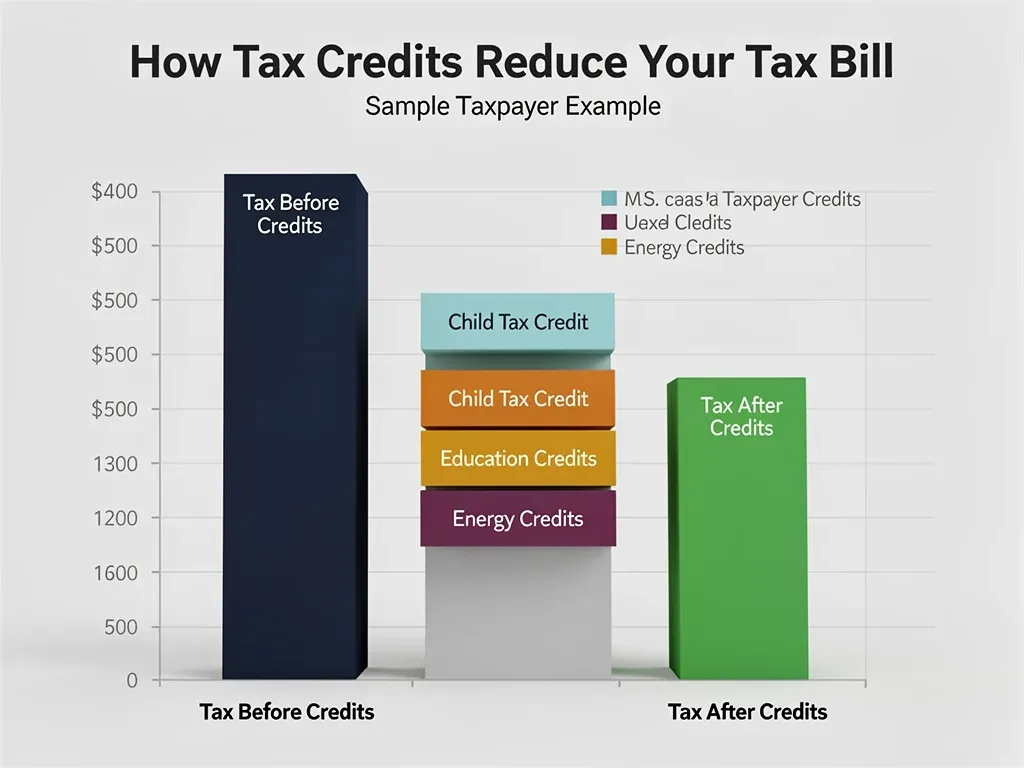
Deductions reduce the amount of income subject to taxation, while credits generally reduce the calculated tax liability directly.
Although credits do not ordinarily reduce taxable income itself, they remain important for taxpayers searching for ways to lower their total federal tax bill.
Key Tax Credits to Consider for 2026
Family-related tax credits may provide financial relief to eligible households with qualifying children or other dependents.
Education credits may also be available for qualifying higher education expenses, subject to income limits and other IRS requirements.
When evaluating how to reduce 2026 taxable income, taxpayers should distinguish these direct tax benefits from deductions that affect taxable income calculations.
Child Tax Credit: Review eligibility for qualifying children and household circumstances.
Child and Dependent Care Credit: Consider eligible expenses associated with qualifying care.
Education Credits: Check requirements for the American Opportunity and Lifetime Learning credits.
Retirement Savings Credits: Determine whether income and contribution requirements are satisfied.
Important Changes to Energy and Vehicle Credits
Several federal clean energy and vehicle incentives ended earlier than previously expected following legislation enacted in 2025.
The federal credits for qualifying new and previously owned clean vehicles generally are not available for vehicles acquired after September 30, 2025.
Similarly, the Energy Efficient Home Improvement Credit and Residential Clean Energy Credit generally do not apply to new qualifying improvements or expenditures after December 31, 2025, subject to the relevant statutory rules.
Strategic Investment and Retirement Planning
Investment decisions can affect taxable income through capital gains, capital losses, dividends, and other investment-related transactions.
Understanding how these transactions are taxed may help investors manage their overall financial position more effectively.
However, decisions made solely for tax purposes can create unnecessary investment risks, making careful planning essential.
Understanding Capital Gains and Holding Periods
Profits from selling investments may be taxed differently depending on how long the asset was held and the taxpayer's income.
Long-term capital gains generally receive different federal income tax treatment from short-term gains, although exceptions and additional taxes may apply.
Investors considering how to reduce 2026 taxable income should review both the potential tax consequences and the financial reasons for selling an asset.
Tax-Loss Harvesting and Investment Losses
Tax-loss harvesting involves realizing eligible investment losses that may offset taxable capital gains.
When allowable capital losses exceed gains, individuals generally may deduct up to $3,000 of the remaining net loss against ordinary income, or $1,500 for married individuals filing separately.
Additional unused eligible losses may be carried forward under IRS rules, but investors must also consider restrictions such as the wash-sale rule.
Avoiding Wash-Sale Rule Problems
The wash-sale rule can prevent an immediate deduction when a taxpayer sells a security at a loss and acquires substantially identical securities within the applicable period.
This period generally includes the 30 days before and the 30 days after the sale, creating a 61-day window that requires careful attention.
Taxpayers should review investment transactions across relevant accounts and seek qualified advice when implementing complex loss-harvesting strategies.
Business Expenses and Self-Employment Deductions
Self-employed individuals and small business owners may qualify to deduct ordinary and necessary expenses related to their business activities.
These deductions generally reduce business profit, which can influence taxable income and other applicable tax calculations.
For business owners researching how to reduce 2026 taxable income, accurate financial records are fundamental to identifying legitimate deductions.
Key Business Deductions for Self-Employed Individuals
Eligible business expenses may include software, advertising, office supplies, professional services, and certain transportation costs.
However, the deductible amount depends on the nature of each expense and whether it satisfies the applicable federal tax rules.
Personal expenses are generally not deductible merely because they were paid through a business account.
Operating Expenses: Record qualifying software, supplies, advertising, and business services.
Home Office: Review exclusive-use and regular-use requirements where applicable.
Business Travel: Maintain documentation supporting eligible business purposes.
Professional Costs: Identify deductible services and qualifying development expenses.
Understanding the Home Office Deduction
Some self-employed taxpayers may qualify to deduct expenses related to a portion of their home used regularly and exclusively for eligible business purposes.
The IRS provides simplified and regular methods for calculating the deduction, subject to the applicable requirements and limitations.
Employees generally cannot claim a federal home office deduction simply because they work remotely for an employer.
Self-Employed Health Insurance and Retirement Planning
Eligible self-employed individuals may qualify for deductions related to health insurance premiums and contributions to certain retirement plans.
Retirement arrangements such as SEP IRAs and one-participant 401(k) plans may provide additional contribution opportunities depending on business income and plan rules.
These arrangements can support efforts to reduce 2026 taxable income, but contribution limits and deduction eligibility require careful calculation.
Charitable Contributions and Tax-Efficient Giving
Charitable donations may provide federal income tax deductions when contributions are made to eligible organizations and applicable requirements are met.
Tax year 2026 includes changes affecting both taxpayers who itemize deductions and those who choose not to itemize.
For individuals considering how to reduce 2026 taxable income, these rules make it important to review donation records and understand which deduction method applies.
New Charitable Deduction for Non-Itemizers
Beginning in 2026, qualifying taxpayers who do not itemize may claim a deduction for certain cash contributions to eligible charitable organizations.
The maximum amount is generally $1,000 for eligible taxpayers or $2,000 for married couples filing jointly, subject to the relevant limitations.
This provision can provide a deduction even when the taxpayer uses the standard deduction, making donation documentation especially important.
Updated Rules for Itemized Charitable Deductions
Taxpayers who itemize may deduct qualifying charitable contributions subject to applicable percentage limits and other restrictions.
Beginning in 2026, an additional limitation generally permits itemizers to deduct charitable contributions only to the extent they exceed 0.5% of adjusted gross income, subject to the applicable rules.
Consequently, the amount donated does not always equal the amount deductible, and taxpayers should consider these changes when planning charitable giving.
Donating Appreciated Investments
Donating eligible appreciated securities directly to a qualified charity may offer tax advantages in certain circumstances.
Depending on the type of asset, holding period, recipient organization, and applicable limits, the donation may avoid a taxable sale while supporting a charitable deduction.
Because special valuation and deduction rules apply, substantial noncash contributions should be reviewed with a qualified tax professional.
Can You Reduce 2026 Taxable Income by 10%?
A 10% reduction in taxable income is possible in some circumstances, but the percentage is not a guaranteed result of any universal tax strategy.
The outcome depends on the taxpayer's starting income, eligibility, filing status, available deductions, and contribution decisions.
Understanding the calculation helps taxpayers evaluate how to reduce 2026 taxable income without confusing a reduction in taxable income with an identical reduction in the final tax bill.
A Hypothetical 10% Taxable Income Reduction
Suppose a taxpayer initially expects $80,000 in federal taxable income before making additional qualifying adjustments.
If eligible deductions or other applicable changes reduce that amount by $8,000, the revised taxable income would be $72,000, representing a 10% reduction.
However, the actual reduction in federal income tax would depend on the applicable tax rates and individual circumstances, rather than automatically equaling $8,000 or 10% of the original tax bill.
Why Tax Savings Vary Between Households
Two taxpayers earning similar amounts may have different deductions because of filing status, retirement plan participation, family circumstances, and business activities.
Some deductions also have income restrictions, contribution limits, or eligibility requirements that prevent taxpayers from claiming their full value.
Therefore, a personalized calculation is necessary before estimating how much a particular strategy could reduce taxable income or tax liability.
Understanding Tax Law Changes and Seeking Professional Advice
Federal tax regulations can change through legislation, inflation adjustments, and updated IRS guidance.
For 2026, taxpayers should pay particular attention to changes involving standard deductions, retirement contributions, charitable giving, and expired federal incentives.
Staying informed is especially important for anyone developing strategies to reduce 2026 taxable income while managing broader financial priorities.
The Value of Professional Tax Guidance
Qualified tax professionals can evaluate individual circumstances and identify deductions, credits, or planning opportunities that apply under current law.
Their assistance may be useful for taxpayers with business income, substantial investments, complex deductions, or financial arrangements involving multiple states.
Professional advice does not guarantee a lower tax bill, but it can help reduce errors and improve compliance with federal reporting requirements.
Why Documentation Matters
Accurate records support deductions and credits claimed on a federal tax return and make it easier to respond to questions about reported information.
Taxpayers should organize contribution statements, receipts, business records, and other documents associated with potential tax benefits.
Keeping records throughout the year is generally more efficient than attempting to reconstruct financial information during the filing season.
Reviewing Your Tax Strategy Before Year-End
As the end of 2026 approaches, taxpayers can compare estimated income with their planned deductions and retirement contributions.
Some transactions need to be completed within the calendar year, while certain contributions may have deadlines extending into the following filing season.
Reviewing the relevant rules before taking action can help taxpayers make informed decisions without missing applicable deadlines.
Summary of Strategies to Reduce 2026 Taxable Income
The most suitable tax-planning strategy depends on personal income, financial goals, and eligibility for specific deductions or credits.
Retirement contributions, qualifying business expenses, and certain charitable donations may reduce taxable income, while eligible credits directly affect tax liability.
The following table summarizes important considerations for taxpayers exploring how to reduce 2026 taxable income.
Key Strategy | Brief Description |
|---|---|
Maximize Deductions | Review eligible traditional retirement contributions, HSA contributions, and applicable standard or itemized deductions. |
Leverage Tax Credits | Identify available family, education, and retirement-related credits that may reduce federal tax liability directly. |
Strategic Investments | Consider retirement planning, investment holding periods, and eligible capital-loss strategies. |
Professional Advice | Seek qualified assistance for complex tax situations and verify current IRS requirements. |
Frequently Asked Questions About Reducing 2026 Taxable Income
What is the most effective way to reduce 2026 taxable income?▼
The most effective approach depends on your financial situation and eligibility. Traditional retirement contributions, qualifying HSA deposits, legitimate business expenses, and applicable deductions may reduce taxable income. Tax credits can also lower your final tax liability, although they generally do not reduce taxable income itself. A personalized review can help identify the most appropriate options.
How do tax credits differ from deductions in reducing taxable income?▼
Tax deductions generally reduce the amount of income subject to taxation, while tax credits reduce the calculated tax liability directly. For example, a $1,000 deduction does not automatically produce $1,000 in tax savings. A qualifying $1,000 credit may reduce tax liability by up to $1,000, depending on the applicable rules and whether the credit is refundable.
Can self-employed individuals significantly reduce 2026 taxable income?▼
Eligible self-employed taxpayers may reduce taxable income through legitimate business expenses, qualifying home office deductions, retirement plan contributions, and certain other adjustments. The actual savings depend on business profit, expense eligibility, contribution limits, and personal circumstances. Accurate documentation is essential for supporting the deductions claimed.
What role does charitable giving play in reducing taxable income?▼
Qualifying charitable contributions may reduce taxable income under federal tax rules. Beginning in 2026, eligible non-itemizers may deduct up to $1,000 in qualifying cash donations, or $2,000 for married couples filing jointly. Taxpayers who itemize face different limitations, including a new 0.5% adjusted gross income threshold. The applicable rules depend on the donation and taxpayer.
When should I start planning to reduce my 2026 taxable income?▼
Tax planning is most effective when reviewed throughout the year. However, taxpayers can still evaluate available opportunities before December 31, 2026, including eligible retirement contributions, charitable giving, and investment transactions. Certain contributions may have later deadlines, so it is important to verify the relevant rules before making financial decisions.
Looking Ahead: Sustained Tax Efficiency
Learning how to reduce 2026 taxable income involves more than identifying deductions at the end of the year. Effective planning considers retirement savings, investment decisions, business expenses, and changes to federal tax law.
Some strategies directly lower taxable income, while others reduce the final tax bill or provide benefits over a longer period. Understanding these differences helps taxpayers avoid unrealistic expectations about guaranteed savings.
By reviewing official IRS guidance, keeping accurate financial records, and seeking qualified advice when necessary, U.S. taxpayers can make more informed decisions about their 2026 federal income taxes.