Real Estate Market Trends in 2026: Financial Analysis for US
Advertisements
Real Estate Market Trends in 2026: A Financial Analysis for U.S. Homeowners and Investors examines mortgage rates, property prices, housing inventory, investment opportunities, and regional market differences. Discover the latest official indicators and practical considerations for making informed real estate decisions.
Real Estate Market Trends in 2026: A Financial Analysis for U.S. Homeowners and Investors reveals a housing market shaped by borrowing costs, affordability pressures, and changing regional demand. These conditions influence buying, selling, refinancing, and investment decisions.
Recent figures show that mortgage rates remain an important financial consideration, while property prices and inventory levels vary across markets. National statistics offer useful context, but local economic conditions often determine individual outcomes.
Understanding these developments can help homeowners evaluate their equity and investors assess potential opportunities. This guide examines the latest available data, financial risks, and practical strategies for navigating the U.S. property market.
Understanding the Economic Landscape for 2026
The American housing market continues to respond to interest rates, inflation, employment conditions, and property availability. These economic forces influence both the cost of purchasing homes and the financial performance of existing properties.
Changes in borrowing expenses can affect buyer demand, while construction costs influence the supply of new housing. Regional differences complicate the outlook because local employment and population trends do not develop uniformly.
For anyone studying real estate market trends in 2026, evaluating several economic indicators together provides more reliable insight than focusing exclusively on national home prices or mortgage rates.
Interest Rate Projections and Their Impact
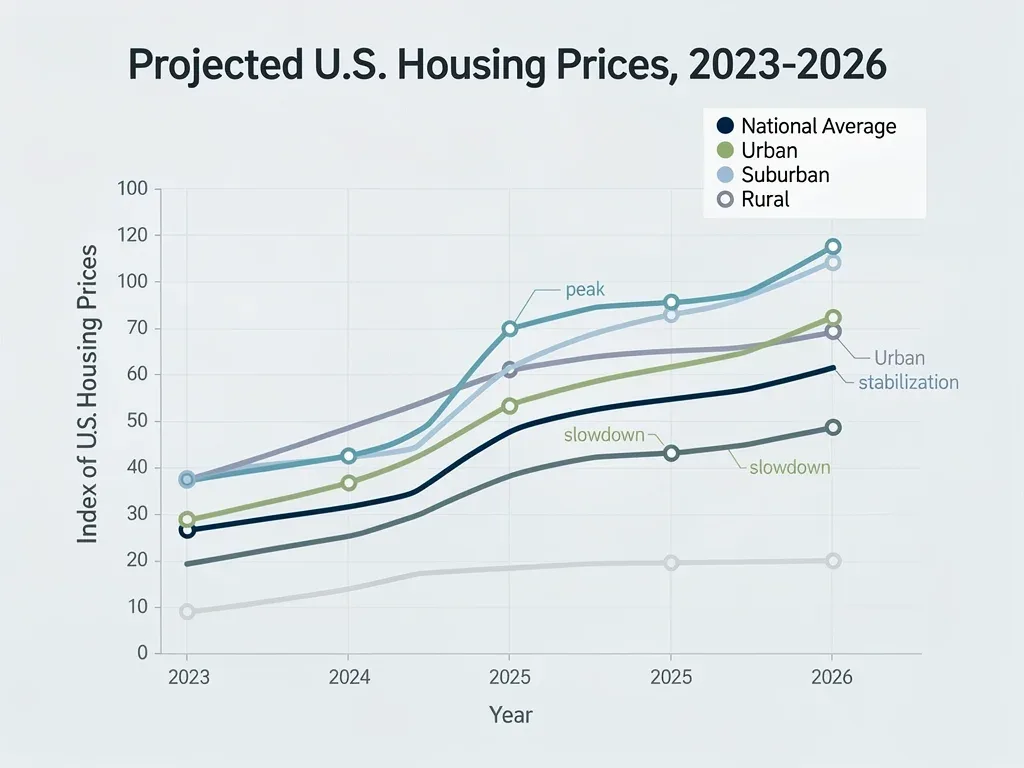
Mortgage rates remain central to housing affordability because they influence monthly loan payments and total borrowing expenses. According to Freddie Mac, the average 30-year fixed mortgage rate reached 7.24% on October 29, 2026.
This was lower than the previous week's 7.32%, although rates remained above the 6.17% average recorded one year earlier. The comparison illustrates why buyers should evaluate financing conditions rather than assume borrowing costs will continually decline.
Federal Reserve decisions influence financial markets, but mortgage rates also respond to bond yields and investor expectations. Consequently, a change in the federal funds rate does not guarantee an identical movement in mortgage borrowing costs.
Inflationary Pressures and Construction Costs
Construction expenses reflect the prices of materials, equipment, transportation, labor, and land development. Changes in these components can affect how builders price new homes and evaluate future projects.
Higher building costs may limit the financial feasibility of certain developments, particularly when buyer demand becomes sensitive to mortgage rates. However, builders can also respond through incentives, smaller floor plans, and alternative construction methods.
Homeowners planning renovations should obtain current contractor estimates rather than relying on historical pricing assumptions. Comparing materials, labor requirements, and project timelines can help prevent unexpected spending during construction.
Housing Inventory and Market Liquidity
Housing inventory measures the number of properties available for purchase and provides insight into supply conditions. When more homes are listed, buyers may gain additional options, although demand determines the resulting price pressure.
The U.S. Census Bureau estimated 476,000 new houses available for sale at the end of September 2026. At the prevailing sales pace, that represented approximately 8.4 months of new-home supply.
These statistics describe newly constructed homes and should not be confused with existing-home inventory. Understanding the distinction helps homeowners and investors interpret changes across different segments of the housing market.
Residential Market Dynamics: Homeowners' Perspective
For existing homeowners, changes in property values, financing conditions, and neighborhood demand can affect important financial decisions. Selling, refinancing, or renovating requires an understanding of both personal finances and local market conditions.
National property statistics provide a useful reference, but individual homes may appreciate or decline differently. Location, maintenance, school access, employment opportunities, and available competing listings can influence market value.
Evaluating real estate market trends in 2026 from a homeowner's perspective therefore requires attention to equity, monthly housing costs, and the practical expenses associated with changing properties.
Property Value Trends and Equity Growth
Home equity represents the difference between a property's estimated market value and the outstanding debt secured against it. Mortgage payments that reduce principal can increase equity even when property prices remain relatively stable.
The Federal Housing Finance Agency reported that U.S. house prices increased 2.6% from July 2025 to July 2026. However, price movements differed significantly across Census divisions, illustrating the importance of regional analysis.
Homeowners should use recent comparable property sales and realistic estimates of selling expenses when evaluating equity. An increase in estimated property value does not automatically translate into cash that can be accessed without additional costs.
Refinancing Opportunities and Mortgage Management
Refinancing replaces an existing mortgage with another loan, potentially offering different interest rates, repayment periods, or monthly payments. Whether refinancing makes financial sense depends on the current loan and available offers.
Lower monthly payments may result from an improved interest rate or a longer repayment term. However, extending the loan can increase total interest expenses, even when the immediate monthly obligation becomes more manageable.
Before refinancing, compare closing costs, the new loan balance, repayment timelines, and expected savings. Homeowners planning to move soon should also consider whether potential benefits justify the upfront expenses.
Should Homeowners Sell or Stay in 2026?
Deciding whether to sell depends on personal circumstances, local housing demand, and the financial consequences of moving. A homeowner with an affordable existing mortgage may face significantly higher payments when financing another property.
Selling expenses, moving costs, property taxes, and insurance should also be considered. A higher selling price does not necessarily produce a better financial outcome if replacement housing becomes substantially more expensive.
Homeowners can compare the total cost of remaining with the expected expenses of relocating. This analysis helps separate lifestyle preferences from the financial implications of entering the current housing market.
Investment Strategies for 2026: A Deep Dive
Real estate investors face opportunities and risks associated with property values, rental demand, financing costs, and operating expenses. Successful investment decisions depend on careful analysis rather than expectations of guaranteed appreciation.
Different property categories respond to economic changes in different ways. Residential rentals, commercial buildings, industrial facilities, and publicly traded real estate investments each present distinct financial characteristics.
For investors evaluating real estate market trends in 2026, estimating realistic cash flow and understanding potential downside scenarios are essential. A property's purchase price is only one component of its financial performance.
Emerging Markets and Niche Sectors
Secondary metropolitan areas may attract investor attention when employment opportunities, population changes, and housing affordability support demand. However, smaller markets do not automatically outperform larger cities.
Purpose-built rental communities, senior housing, and specialized industrial properties represent different investment categories worth examining. Their financial performance depends on occupancy, operating expenses, financing, and local market competition.
Investors should review historical rent trends, employment data, construction activity, and comparable transactions before selecting a location. Broad regional narratives cannot replace property-specific due diligence.
Risk Management and Portfolio Diversification
Real estate investments involve risks associated with vacancies, repairs, financing, insurance, and changing property values. Concentrating too much capital in one location or property type can increase exposure to localized problems.
Diversification may involve multiple geographic markets, different property categories, or real estate investment trusts. However, diversification does not eliminate losses during broader economic downturns.
Maintaining appropriate cash reserves and avoiding excessive leverage can improve financial flexibility. Investors should evaluate whether a property remains manageable under lower rental income or higher operating expenses.
Evaluating Rental Property Cash Flow
Rental property analysis begins by estimating rental income and subtracting expenses such as taxes, insurance, maintenance, management fees, and vacancy allowances. Financing costs must also be incorporated when debt is involved.
Positive cash flow depends on realistic assumptions about occupancy and spending. Underestimating repairs or assuming uninterrupted rental income can make an investment appear more attractive than its actual performance.
Investors should also account for major future expenses, including roof replacement and essential mechanical systems. Evaluating several financial scenarios provides a clearer picture of potential returns and risks.
Technological Innovations Shaping the Market
Technology influences how properties are marketed, evaluated, financed, and managed. Digital listing systems, online documents, and property management platforms can streamline selected activities for buyers, sellers, and investors.
Advancements in artificial intelligence (AI) and data analytics offer additional tools for interpreting property information. However, automated estimates can be inaccurate when relevant local characteristics are missing.
Understanding technology's role in real estate market trends in 2026 requires separating practical improvements from exaggerated claims. Digital tools should support professional judgment rather than replace necessary research and verification.
AI and Data Analytics in Real Estate
AI-powered applications can assist with analyzing property listings, identifying patterns, and organizing market information. Their usefulness depends on data quality, model design, and the questions being evaluated.
Automated valuation models may provide preliminary estimates based on comparable sales and property characteristics. However, unusual homes, recent renovations, and rapidly changing neighborhoods can produce significant estimation errors.
Investors and homeowners should compare automated results with verified records and local professional assessments. Technology may improve efficiency, but it cannot guarantee accurate property values or future returns.
Sustainable Building and Smart Home Technologies
Energy-efficient construction and home technologies can influence operating expenses and buyer preferences. Insulation improvements, efficient heating systems, and appropriate building design may reduce energy consumption under suitable conditions.
Smart thermostats, monitoring devices, and automated controls can provide convenience and information about household systems. However, equipment installation, maintenance, and compatibility affect the overall financial benefit.
These features do not guarantee higher resale values in every market. Homeowners should compare upfront costs with expected savings and consider whether improvements match local buyer preferences.
Digital Transactions and Property Management
Online transaction platforms can simplify document exchange, communication, and selected administrative tasks. Their availability depends on local requirements, lender procedures, and the organizations involved in a property transaction.
Property management software may assist landlords with rent records, maintenance requests, and financial reporting. These features can improve organization, especially when managing several units.
However, sensitive financial and tenant information requires careful handling. Investors should assess data security, subscription costs, and legal obligations before adopting digital management systems.
Regulatory Environment and Policy Changes
Real estate markets are influenced by land-use rules, property taxation, lending requirements, and housing policies. These regulations can affect development feasibility, ownership expenses, and the supply of available properties.
Requirements differ among federal, state, and local jurisdictions, making location-specific research essential. A policy affecting one city may have little relevance to homeowners or investors in another region.
When analyzing real estate market trends in 2026, distinguish existing regulations from proposed changes. Legislative discussions do not guarantee that new rules will be adopted or implemented.
Zoning Laws and Housing Development
Zoning rules determine how land may be used and what types of buildings can be developed in particular areas. These requirements influence residential density, commercial activity, and the feasibility of new construction.
Some municipalities evaluate changes that could permit additional housing types or greater density. However, the financial effects depend on local infrastructure, construction costs, and the final regulations adopted.
Investors considering development projects should verify current zoning, permitting requirements, and applicable restrictions. Future policy changes should not be treated as guaranteed investment opportunities.
Taxation and Affordability Initiatives
Property taxes, mortgage interest rules, and potential capital gains obligations can influence the financial consequences of owning or selling real estate. Specific treatment depends on federal and local requirements and individual circumstances.
Housing assistance and first-time buyer programs may help eligible households access financing or address certain purchasing expenses. However, benefits, funding, and eligibility conditions vary considerably among programs.
Homeowners and investors should verify applicable rules through official sources and qualified professionals. Financial decisions should reflect current legal requirements rather than assumptions about future legislation.
Insurance Costs and Climate Exposure
Property insurance represents an important ownership expense that can change over time. Premiums may reflect rebuilding costs, location-specific hazards, coverage selections, and insurer underwriting decisions.
Properties exposed to flooding, wildfires, or severe storms may require additional evaluation. Available coverage and premiums can differ significantly even between neighborhoods within the same metropolitan area.
Before purchasing, request realistic insurance estimates and investigate known property risks. Investors should include these expenses in financial models rather than relying on previous owners' historical premiums.
Geographic Shifts and Demographic Influences
Regional housing conditions respond to employment opportunities, household formation, migration, and affordability. These factors help explain why property values and sales activity do not move uniformly across the United States.
Population growth can support housing demand, but development activity and local income levels also influence prices. A growing community may experience different outcomes depending on how quickly new housing becomes available.
Analyzing real estate market trends in 2026 therefore requires examining individual cities and neighborhoods. Broad labels such as the Sun Belt or Mountain West describe large areas with considerable internal differences.
Migration Patterns and Regional Growth
The Sun Belt includes a broad group of southern and southwestern states that have experienced important demographic and economic changes. However, growth rates differ across their metropolitan areas.
Employment opportunities, housing expenses, taxes, climate conditions, and family circumstances can influence relocation decisions. These factors may support demand in some locations while limiting affordability in others.
Investors should review current migration estimates alongside local employment and housing construction data. Historical population growth alone does not guarantee continued property appreciation.
Generational Preferences and Housing Demand
Housing preferences vary by age, income, family size, and lifestyle rather than following uniform generational patterns. Some households prioritize larger homes, while others place greater value on location and lower maintenance requirements.
Older homeowners may consider accessible properties or smaller residences, although many prefer remaining in their existing homes. Younger buyers may face affordability challenges despite having stable employment.
Developers and investors can use demographic information to understand potential demand, but individual market research remains necessary. Broad generational assumptions should not substitute for verified local housing needs.
Comparing Urban, Suburban, and Rural Markets
Urban markets may offer access to employment centers, transportation, and services, although purchase prices and ownership expenses can be comparatively high. Demand conditions vary substantially among individual neighborhoods.
Suburban locations may appeal to households seeking additional space or different housing options. However, longer commutes, transportation costs, and property maintenance can influence affordability.
Rural properties may offer lower purchase prices in certain areas, but financing, infrastructure, and resale liquidity can present challenges. Comparing total ownership expenses provides a more useful financial perspective than comparing listing prices alone.
Challenges and Opportunities for 2026
The 2026 housing market presents difficult affordability decisions for buyers and important financial considerations for existing owners. Mortgage costs, available inventory, and household income remain central to market accessibility.
Investors must also evaluate financing conditions and potential changes in rental demand. Properties that appear attractive based on purchase price alone may carry substantial operating expenses or limited resale flexibility.
Understanding these challenges creates opportunities for more disciplined decision-making. A thoughtful strategy considers realistic costs, financial reserves, and the possibility that market conditions may change unexpectedly.
Affordability Crisis and Market Accessibility
Housing affordability depends on the relationship between home prices, mortgage rates, household income, and ongoing ownership expenses. Even modest changes in borrowing costs can affect the monthly payment required for a purchase.
According to the U.S. Census Bureau, the median sales price of new houses sold in September 2026 was $400,400. This national estimate does not represent the typical price in every local market.
Prospective buyers should calculate total monthly housing costs before committing to a property. Mortgage principal, interest, taxes, insurance, and maintenance all influence whether ownership remains financially manageable.
Navigating Market Volatility and Economic Uncertainties
Property markets can respond to changes in employment, lending conditions, consumer confidence, and broader economic activity. These influences may affect transaction volumes and prices at different speeds.
Homeowners planning to sell should consider the possibility of longer listing periods or changing buyer demand. Investors should evaluate scenarios involving vacancies, unexpected repairs, or refinancing at unfavorable rates.
Maintaining sufficient financial reserves can reduce the pressure to make decisions during difficult conditions. No investment strategy eliminates risk, but realistic planning helps prepare for uncertain outcomes.
Opportunities for Long-Term Investors
Long-term investors may focus on properties with sustainable rental demand, manageable expenses, and financing that fits their financial circumstances. The objective is to evaluate potential performance over several years.
Property improvements, effective management, and careful tenant selection may influence operating results. However, these measures do not guarantee appreciation or uninterrupted rental income.
Before investing, compare possible returns with alternative uses of capital and the risks involved. Long-term ownership should remain financially sustainable even if market prices grow more slowly than expected.
Future Outlook and Long-Term Projections
Beyond 2026, the housing market will continue responding to demographic changes, construction activity, financing conditions, and broader economic developments. These influences create different possibilities across property types and geographic locations.
Climate exposure, infrastructure quality, and changing employment arrangements may also influence demand. However, their long-term effects depend on local circumstances and cannot be expressed as guaranteed property appreciation.
Homeowners and investors can benefit from regularly evaluating financial assumptions rather than relying on fixed long-term predictions. A property that fits current goals should also remain manageable under less favorable conditions.
Sustainable Development and Resilient Infrastructure
Resilient infrastructure and efficient building design may influence the long-term usefulness and operating expenses of properties. Drainage systems, reliable utilities, and appropriate construction standards can be important considerations.
However, homes in areas with strong infrastructure do not automatically command higher prices. Local demand, insurance availability, neighborhood conditions, and property characteristics continue shaping market value.
Before purchasing, investigate known environmental risks and maintenance responsibilities. Evaluating these factors alongside financing costs can support more complete long-term real estate decisions.
The Role of Remote Work in Future Housing
Remote and hybrid work arrangements have influenced housing preferences for certain employees, particularly those who no longer commute to an office every day. However, workplace policies differ across industries and employers.
Some households may prioritize dedicated office space, while others continue valuing proximity to employment centers and public transportation. These preferences can influence demand without producing a uniform national migration pattern.
Investors should evaluate local employment structures and actual rental demand before assuming remote work will create sustained growth. Housing choices remain influenced by multiple economic and personal factors.
What Homeowners and Investors Should Monitor Next

Mortgage rates, home sales, inventory, and local employment conditions will remain useful indicators for understanding the housing market. Official releases provide more reliable reference points than unsupported forecasts.
For homeowners, reviewing equity, insurance expenses, and refinancing opportunities may be appropriate as financial conditions change. Investors should monitor rent collections, operating costs, and property-specific performance.
Future reports may confirm new patterns or challenge existing expectations. Remaining flexible and using updated information can help prevent decisions based on assumptions that no longer reflect current conditions.
Key Financial Indicators for Real Estate in 2026
The latest available housing statistics highlight the importance of evaluating borrowing costs, sale prices, and inventory together. Each indicator provides information about a different part of the market.
Freddie Mac reported an average 30-year mortgage rate of 7.24% on October 29, while the Census Bureau reported a September median new-home sales price of $400,400. Neither figure describes every buyer's situation.
The following table summarizes the main financial considerations associated with real estate market trends in 2026. These factors can help guide further research without replacing a property-specific financial assessment.
Key Aspect | Financial Implication |
|---|---|
Interest Rate Fluctuations | Changes in mortgage rates affect borrowing costs, monthly payments, and the financial feasibility of property purchases. |
Regional Market Divergence | Local differences in employment, inventory, and housing demand make neighborhood-level research essential. |
Technological Integration | Digital tools can support property analysis and management, but their accuracy depends on reliable data and appropriate use. |
Policy and Regulatory Shifts | Changes in zoning, taxation, and housing programs may influence ownership costs and development opportunities. |
Frequently Asked Questions About 2026 Real Estate Trends
What are the main factors influencing U.S. real estate in 2026?
The main factors include mortgage rates, housing affordability, property inventory, employment conditions, construction costs, and regional demand. These influences can produce different outcomes across the United States. According to Freddie Mac, the average 30-year fixed mortgage rate was 7.24% on October 29, 2026, while recent Census Bureau data showed important changes in new-home sales and inventory.
How will interest rates impact homeowners and investors in 2026?
Mortgage rates influence monthly payments, refinancing opportunities, and the cost of financing investment properties. Higher rates can reduce purchasing power, while lower rates may improve affordability for some borrowers. However, actual loan offers depend on credit qualifications, mortgage terms, lender requirements, and market conditions. Homeowners and investors should compare complete financing costs rather than focusing only on advertised rates.
Which regions are expected to see significant growth in 2026?
There is no guaranteed list of regions that will outperform the broader housing market. Areas with employment growth, favorable affordability, and balanced construction activity may offer opportunities, but outcomes vary within states and metropolitan areas. Investors should review local employment, migration, housing inventory, and comparable property transactions before selecting markets based on broad regional forecasts.
What technological advancements will shape the real estate market in 2026?
Digital property platforms, AI and data analytics, automated valuation tools, and property management systems can support market research and operational efficiency. Smart home equipment and energy-efficient construction may also influence buyer preferences. However, technology cannot guarantee accurate property valuations, improved investment returns, or higher resale prices in every location.
What challenges should homeowners and investors anticipate in 2026?
Important challenges include housing affordability, mortgage expenses, maintenance costs, insurance, and differences between local markets. Investors must also consider vacancy risk, financing requirements, and possible changes in property values. Maintaining financial reserves, reviewing current data, and evaluating realistic cost scenarios can support more informed decisions when conditions become uncertain.
Looking Ahead: Strategic Imperatives for Real Estate in 2026
Real Estate Market Trends in 2026: A Financial Analysis for U.S. Homeowners and Investors highlights the importance of examining borrowing costs, local property conditions, and financial risks before making major decisions.
Recent official statistics demonstrate that market conditions are changing, but national indicators cannot predict individual property outcomes. Mortgage terms, neighborhood demand, insurance costs, and personal financial goals all require separate consideration.
Homeowners and investors can improve their decision-making through realistic budgeting, reliable market research, and careful evaluation of alternatives. A disciplined approach remains useful whether the objective is purchasing a home, managing an existing property, or considering long-term investments.