Navigating 2026 Fed Rate Hikes: 3-Month Household Impact
Advertisements
The 2026 Federal Reserve interest rate hikes can influence household borrowing costs, mortgage affordability, credit card payments, savings returns, and investment strategies, making proactive financial planning essential for American families.
Understanding the 2026 Federal Reserve interest rate hikes is essential for American households navigating changing borrowing costs, investment conditions, savings opportunities, and everyday financial obligations.
Following September's interest rate increase and October's decision to maintain rates, effective financial planning remains important for households managing debt and preparing for potential economic changes.
This three-month financial impact analysis examines how monetary policy decisions could influence household expenses, providing practical strategies for managing financial uncertainty and maintaining long-term economic stability.
Understanding the Federal Reserve's Mandate and 2026 Outlook
The Federal Reserve operates under a dual mandate focused on achieving maximum employment and maintaining stable prices through monetary policy decisions that influence national economic conditions.
The 2026 Federal Reserve interest rate hikes reflect ongoing efforts to address inflationary pressures while evaluating employment conditions, consumer spending, and broader developments throughout financial markets.
Changes to the federal funds rate can influence borrowing expenses and savings opportunities, although individual financial products respond differently depending on market conditions and contractual arrangements.
The Current Federal Reserve Interest Rate in 2026

On September 16, 2026, the Federal Reserve increased its benchmark interest rate target range by 25 basis points, bringing it to between 3.75% and 4.00%.
According to the official Federal Reserve monetary policy statement published on October 28, 2026, policymakers subsequently decided to maintain the existing interest rate range.
Although inflation remains elevated, future adjustments will depend on incoming economic information, making additional rate increases possible but not guaranteed during the following three months.
The Rationale Behind Interest Rate Adjustments
The Federal Reserve may increase interest rates when inflationary pressures threaten price stability, using higher borrowing costs to moderate consumer demand and broader economic activity.
Conversely, reducing interest rates can encourage borrowing and investment during periods of weaker economic activity, although monetary policy decisions require careful consideration of multiple economic indicators.
Understanding the 2026 Federal Reserve interest rate hikes requires monitoring inflation, employment statistics, economic growth, consumer demand, and official announcements regarding future monetary policy decisions.
Immediate Impact on Mortgage Rates and Housing Costs
One important consideration for American households involves the potential influence of monetary policy decisions on mortgage rates, housing affordability, and residential financing expenses.
The 2026 Federal Reserve interest rate hikes can indirectly influence mortgage pricing through financial market expectations, Treasury bond yields, and changes affecting the mortgage-backed securities market.
Prospective homebuyers and existing homeowners should evaluate their individual financing arrangements carefully, particularly when considering new mortgages, adjustable-rate products, or refinancing opportunities during changing market conditions.
How Rate Hikes Influence New Home Purchases
Higher mortgage interest rates can increase monthly housing payments, reducing the purchasing power of prospective buyers even when residential property prices remain relatively stable.
For households operating within limited budgets, increased financing expenses may require reconsidering preferred locations, property sizes, down payment amounts, or the timing of a home purchase.
Although the 2026 Federal Reserve interest rate hikes can influence housing market conditions, mortgage rates also depend on lender competition, credit profiles, and broader investment market developments.
Effects on Existing Homeowners With Adjustable-Rate Mortgages
Homeowners with adjustable-rate mortgages may experience changes to their monthly payments when their contractual interest rates reset according to an applicable benchmark and predetermined lending terms.
The timing and magnitude of these adjustments depend on individual mortgage agreements, including interest rate caps, adjustment schedules, and the particular financial index used by lenders.
Reviewing mortgage documents can help homeowners understand their exposure to the 2026 Federal Reserve interest rate hikes and prepare for possible increases in future monthly payments.
What Happens to Existing Fixed-Rate Mortgages?
Homeowners with existing fixed-rate mortgages generally retain their contracted interest rates throughout the applicable repayment period, regardless of changes to the federal funds rate.
However, total monthly housing expenses can still increase because of adjustments involving property taxes, homeowners insurance, association fees, or other expenses unrelated to mortgage interest rates.
Consumers considering refinancing should compare available interest rates, closing costs, repayment terms, and potential long-term savings before replacing an existing fixed-rate mortgage with another financing arrangement.
Impact on Consumer Credit and Household Debt
The 2026 Federal Reserve interest rate hikes can affect consumer credit products differently, depending on whether individual borrowing arrangements feature fixed interest rates or variable pricing structures.
Credit cards with variable annual percentage rates may respond relatively quickly to monetary policy changes, while existing fixed-rate installment loans generally retain their original contractual rates.
Understanding these distinctions helps households identify which financial obligations require immediate attention and which expenses are unlikely to change directly following additional monetary policy adjustments.
Rising Costs for Credit Card Debt
Many American credit cards feature variable annual percentage rates linked to benchmark rates, meaning borrowing expenses may increase when changes in monetary policy influence these benchmarks.
Households carrying revolving balances could experience higher interest charges following additional rate increases, potentially making debt repayment more expensive if monthly payments remain relatively unchanged.
Managing credit card balances is particularly important during the 2026 Federal Reserve interest rate hikes because reducing outstanding principal can help limit exposure to rising borrowing expenses.
Auto Loan and Personal Loan Considerations
Interest rates on newly issued automobile loans and personal loans can respond to changing financial conditions, although individual borrowing costs also depend on creditworthiness and lender policies.
Existing fixed-rate auto loans and personal loans generally maintain their contracted rates, while variable-rate agreements may experience adjustments according to their specific contractual provisions.
Consumers planning significant purchases should compare financing offers carefully, considering annual percentage rates, repayment periods, applicable fees, and total interest expenses before accepting new borrowing arrangements.
Home Equity Lines of Credit and Variable Debt
Home equity lines of credit frequently feature variable interest rates, making their borrowing costs particularly sensitive to changes involving benchmark rates and broader monetary policy conditions.
Households with outstanding balances should review adjustment schedules and payment requirements to understand how additional interest rate increases could influence their monthly financial obligations.
Evaluating these borrowing arrangements alongside credit cards and other variable-rate debts provides a more comprehensive understanding of exposure to the 2026 Federal Reserve interest rate hikes.
Savings Accounts and Investment Returns
Although higher interest rates may increase borrowing expenses, they can also introduce opportunities for households seeking competitive returns through savings products and selected fixed-income investments.
The 2026 Federal Reserve interest rate hikes may influence deposit interest rates, although financial institutions independently determine the annual percentage yields associated with their savings products.
Consumers should evaluate potential savings opportunities alongside accessibility requirements, account conditions, inflationary pressures, and the financial risks associated with different investment or deposit arrangements.
Benefits for High-Yield Savings Account Holders
High-yield savings accounts may offer more competitive interest rates than traditional savings products, particularly when financial institutions adjust deposit pricing in response to changing market conditions.
These accounts can provide convenient access to emergency savings while allowing households to earn interest on available funds without accepting the market risks associated with stocks.
Before transferring savings, compare annual percentage yields, applicable fees, minimum balance requirements, withdrawal conditions, and whether the financial institution provides appropriate federal deposit insurance protections.
Certificates of Deposit and Fixed Savings Returns
Certificates of deposit allow consumers to secure an interest rate for a predetermined period, potentially providing predictable returns when prevailing deposit rates remain financially attractive.
The 2026 Federal Reserve interest rate hikes may improve available rates on newly issued certificates, although existing fixed-rate certificates generally retain their original interest arrangements.
Consumers should carefully evaluate maturity dates and early withdrawal penalties, ensuring that money committed to certificates remains compatible with household liquidity needs and anticipated financial obligations.
Implications for Equity and Bond Markets
Rising interest rates can influence equity valuations by increasing corporate borrowing expenses and changing the discount rates investors apply to expected future earnings and cash flows.
Existing fixed-rate bonds generally experience declining market prices when comparable yields increase, while newly purchased securities may offer more competitive interest income under prevailing market conditions.
Investors should evaluate these developments according to their financial objectives, investment horizons, diversification strategies, and willingness to accept market fluctuations rather than reacting exclusively to economic headlines.
Three-Month Financial Impact Analysis for U.S. Households
The financial consequences of monetary policy adjustments may develop gradually, with different borrowing products and savings accounts responding over varying periods according to market conditions.
A three-month analysis of the 2026 Federal Reserve interest rate hikes provides a practical framework for monitoring household expenses, identifying financial vulnerabilities, and evaluating potential savings opportunities.
Starting from November 2026, households can use the following ninety-day planning framework to prepare for possible changes without assuming that additional interest rate increases are inevitable.
Month One: Review Existing Financial Obligations
During the first month, households should review credit card statements, loan agreements, mortgage documents, and savings account terms to understand their exposure to changing interest rates.
Identify variable-rate debts and confirm when interest charges or monthly payments could change, paying particular attention to borrowing arrangements with substantial outstanding balances.
Establishing a clear financial baseline makes it easier to recognize subsequent changes associated with monetary policy developments and independently evaluate their effects on household budgets.
Month Two: Adjust Spending and Savings Strategies
During the second month, compare updated account statements with previous records to identify changes involving interest expenses, required debt payments, and savings account earnings.
Households affected by the 2026 Federal Reserve interest rate hikes may benefit from adjusting discretionary spending and directing available financial resources toward expensive variable-rate debt.
Reviewing competitive savings products during this period can also reveal opportunities to improve interest earnings while maintaining sufficient access to funds for unexpected expenses.
Month Three: Evaluate Results and Update Financial Plans
During the third month, evaluate whether adjustments to borrowing, spending, and savings strategies have improved household cash flow and reduced exposure to potential financial difficulties.
Compare actual expenses against initial projections, identifying areas where additional changes might strengthen financial flexibility without unnecessarily compromising essential household needs or long-term objectives.
Use these findings to establish realistic financial priorities for subsequent months, taking into account updated Federal Reserve decisions, employment conditions, inflation, and personal financial circumstances.
Practical Examples of Household Financial Impact
Illustrative calculations can help American consumers understand how additional interest rate changes might affect borrowing costs and savings income under specific hypothetical financial circumstances.
These examples examine potential outcomes following a 25-basis-point increase, assuming the relevant financial product passes through the entire adjustment without introducing additional contractual changes.
Actual consequences of the 2026 Federal Reserve interest rate hikes depend on individual financial agreements, outstanding balances, repayment schedules, and decisions made by financial institutions.
Credit Card Debt Example
Consider a household carrying a credit card balance of $10,000 with an annual percentage rate of 22%, assuming the outstanding balance remains unchanged throughout the example.
If the annual percentage rate increases to 22.25%, the additional annual interest expense would be approximately $25, equivalent to around $6.25 over three months.
This simplified example excludes compounding, repayment activity, additional purchases, fees, and daily balance calculations, demonstrating only the approximate effect of a hypothetical quarter-point interest rate increase.
Mortgage Payment Example
Consider a hypothetical $300,000 fixed-rate mortgage with a thirty-year repayment period, comparing monthly principal and interest payments at mortgage rates of 6% and 6.25%.
At 6%, the monthly principal and interest payment would be approximately $1,799, increasing to around $1,847 at the higher illustrative mortgage rate.
This represents approximately $48 in additional monthly expenses, or $144 over three months, excluding property taxes, homeowners insurance, closing costs, and other applicable housing expenses.
Savings Account Earnings Example
Consider a household maintaining $20,000 in an interest-bearing savings account, with the annual percentage yield hypothetically increasing from 3.50% to 3.75% during the analysis period.
Assuming the balance remains unchanged, the higher rate would generate approximately $50 in additional annual interest, equivalent to roughly $12 over a three-month period.
Although the 2026 Federal Reserve interest rate hikes may create savings opportunities, actual earnings depend on account terms, compounding arrangements, balance changes, and bank pricing decisions.
Budgeting and Financial Planning Strategies for Households
Effective financial planning becomes particularly important when households experience changing borrowing expenses, unpredictable income developments, and uncertainty surrounding the future direction of monetary policy.
The 2026 Federal Reserve interest rate hikes highlight the value of regularly reviewing financial commitments and preparing for potential adjustments before they create substantial household pressure.
Maintaining realistic budgets, reducing unnecessary borrowing expenses, and establishing accessible financial reserves can help households strengthen their ability to respond to different economic conditions.
Revisiting Household Budgets and Expense Tracking
Review monthly household expenses by examining bank statements, credit card bills, recurring subscriptions, insurance premiums, loan payments, and other established financial commitments.
Distinguishing essential expenses from discretionary purchases can help identify opportunities to redirect available funds toward rising borrowing expenses, emergency savings, or outstanding financial obligations.
During periods influenced by the 2026 Federal Reserve interest rate hikes, reviewing budgets regularly provides greater flexibility when income levels or mandatory household expenses change.
Prioritizing High-Interest Debt Reduction
Reducing expensive outstanding balances can help households limit future interest charges, particularly when borrowing arrangements feature variable rates that may increase following monetary policy adjustments.
One common approach involves maintaining required minimum payments on all debts while directing additional available funds toward obligations carrying the highest applicable interest rates.
However, debt repayment strategies should also consider emergency savings requirements, potential contractual fees, household income stability, and the importance of meeting essential living expenses consistently.
Building and Reinforcing Emergency Savings
An accessible emergency fund can help households manage unexpected expenses, employment interruptions, medical bills, and temporary financial difficulties without immediately relying on expensive credit products.
A common planning guideline involves gradually building savings sufficient to cover three to six months of essential expenses, although appropriate amounts depend on individual circumstances.
Building financial reserves alongside debt reduction can improve household resilience throughout periods of uncertainty associated with the 2026 Federal Reserve interest rate hikes and broader economic developments.
Evaluating Debt Consolidation Opportunities
Debt consolidation may help certain borrowers simplify repayment arrangements or reduce interest expenses by combining outstanding obligations into a single financing product with different contractual terms.
Before accepting an offer, consumers should compare interest rates, origination fees, repayment periods, and total borrowing expenses rather than focusing exclusively on lower monthly payments.
Consolidation does not automatically reduce overall debt costs, particularly when extended repayment periods or additional borrowing fees outweigh potential financial benefits associated with lower interest rates.
Expert Perspectives and Economic Forecasts
Economic forecasts provide useful context for evaluating potential monetary policy developments, although projections remain dependent on assumptions concerning inflation, employment, consumer spending, and international economic conditions.
The 2026 Federal Reserve interest rate hikes should be evaluated alongside official policy announcements rather than treating individual analyst predictions as confirmed future interest rate decisions.
Households can benefit from understanding different economic scenarios while maintaining financial arrangements that remain manageable even when actual market developments differ from published expectations.
Analyzing Market Reactions and Economic Expectations
Financial markets frequently respond to expectations surrounding monetary policy decisions, meaning stock prices, Treasury bond yields, and currency values may change before official interest rate announcements.
Different market participants may interpret inflation reports, employment statistics, and economic forecasts differently, creating uncertainty regarding the magnitude and direction of potential financial market movements.
Understanding these reactions can help households interpret developments associated with the 2026 Federal Reserve interest rate hikes without relying exclusively on short-term market movements.
Long-Term Economic Outlook Beyond the Three-Month Window
Although short-term financial planning helps households manage immediate expenses, long-term economic conditions also influence employment opportunities, investment performance, borrowing expenses, and future purchasing power.
Major financial objectives, including retirement, homeownership, educational expenses, and long-term savings, require strategies that account for changing economic conditions rather than individual monetary policy announcements.
Maintaining diversified financial arrangements and realistic planning assumptions can help households prepare for multiple interest rate scenarios while pursuing their established long-term financial objectives.
Possible Federal Reserve Interest Rate Scenarios
Preparing for multiple monetary policy outcomes can help households manage uncertainty without becoming excessively dependent on predictions about the future direction of benchmark interest rates.
The 2026 Federal Reserve interest rate hikes provide important context, but subsequent decisions may involve additional increases, unchanged rates, or reductions depending on economic developments.
Each potential outcome presents different considerations for borrowers, savers, investors, and households planning significant purchases throughout the following months and into early 2027.
Scenario One: Additional Interest Rate Increases
If the Federal Reserve implements further increases, households with certain variable-rate debts may experience higher borrowing expenses according to their contractual adjustment mechanisms.
Some savings products could offer improved returns, although financial institutions are not required to pass through monetary policy adjustments proportionally or within identical timeframes.
Under this scenario, reviewing expensive debt obligations, maintaining financial reserves, and comparing available borrowing offers may help households manage potential increases in monthly expenses.
Scenario Two: Interest Rates Remain Unchanged
If policymakers maintain the existing target range, households may experience relative stability in certain benchmark-linked borrowing expenses, although individual financial products can still undergo pricing adjustments.
Mortgage rates, corporate borrowing costs, deposit yields, and investment valuations may continue changing because they depend on broader market conditions beyond the federal funds rate.
Consumers should therefore continue monitoring their financial obligations even when no additional Federal Reserve interest rate adjustments occur during the three-month analysis period.
Scenario Three: Interest Rates Begin to Decline
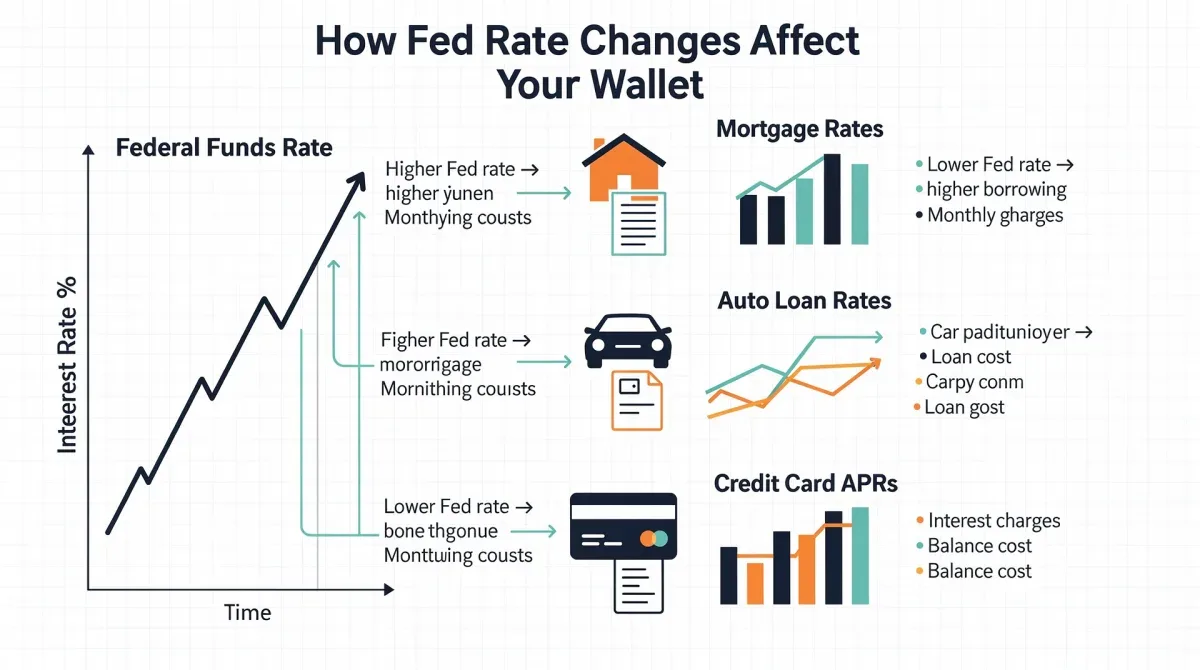
Future interest rate reductions could decrease certain variable borrowing expenses over time, depending on the applicable benchmarks, contractual terms, and pricing decisions made by individual lenders.
Lower benchmark rates could also reduce savings yields and influence the attractiveness of newly issued fixed-income securities compared with previously available investment opportunities.
Households should evaluate refinancing and savings alternatives using actual financial offers rather than assuming that every Federal Reserve rate reduction automatically creates immediate personal financial benefits.
Comparing the Potential Three-Month Financial Effects
The financial consequences of monetary policy depend on household debt levels, existing borrowing agreements, available savings, investment allocations, and the timing of individual financial commitments.
The following comparison summarizes how additional changes following the 2026 Federal Reserve interest rate hikes could influence important areas of American household financial management.
These outcomes represent general possibilities rather than guaranteed financial results, making it essential for consumers to evaluate actual account statements and individual contractual arrangements.
Key Impact Area | Potential Three-Month Effect |
|---|---|
Mortgage Payments | New mortgage rates may fluctuate, while adjustable-rate mortgages could reset according to their contractual terms. |
Fixed-Rate Mortgages | Existing contracted interest rates generally remain unchanged following Federal Reserve policy decisions. |
Consumer Credit | Variable credit card and personal loan rates may increase if corresponding benchmarks rise. |
Auto Loans | New financing offers may become more expensive, while existing fixed-rate agreements generally remain unchanged. |
Savings & CDs | New savings products may offer improved yields, depending on individual financial institution pricing. |
Investment Portfolios | Stock valuations and existing bond prices may fluctuate as investors evaluate changing interest rate expectations. |
Household Budgets | Families may need to adjust discretionary spending and prioritize expensive outstanding debt. |
Emergency Savings | Maintaining accessible financial reserves can help households prepare for unexpected expenses and economic uncertainty. |
Current Federal Funds Rate | The target range remains between 3.75% and 4.00%, following the October 28, 2026 decision. |
Frequently Asked Questions About 2026 Fed Rate Hikes
How will the 2026 Federal Reserve interest rate hikes affect my mortgage?
New mortgage rates may respond to changes in monetary policy and broader financial market conditions. Existing adjustable-rate mortgages could experience payment changes after scheduled resets, while existing fixed-rate mortgage interest rates generally remain unchanged.
What immediate impact can rate hikes have on credit card debt?
Credit cards with variable annual percentage rates may become more expensive when applicable benchmark rates increase. Households carrying outstanding balances could therefore experience higher interest charges depending on their individual credit agreements.
Will my savings accounts earn more interest after additional rate hikes?
Possibly. Financial institutions may increase savings account yields following higher benchmark interest rates. However, deposit pricing varies between providers, and banks are not required to match Federal Reserve adjustments.
How should households adjust their budgets to prepare for interest rate changes?
Households should review existing expenses, identify variable-rate borrowing obligations, prioritize expensive debt, maintain accessible emergency savings, and compare available financial products before accepting new commitments.
What is the current Federal Reserve interest rate?
As of November 17, 2026, the federal funds rate target range remains between 3.75% and 4.00%, following the Federal Reserve's decision to maintain rates on October 28, 2026.
Did the Federal Reserve increase interest rates in September 2026?
Yes. On September 16, 2026, the Federal Reserve announced an increase of 25 basis points, bringing the federal funds rate target range to between 3.75% and 4.00%.
Are additional Federal Reserve interest rate hikes guaranteed in 2026?
No. Future interest rate decisions depend on incoming economic information, inflation developments, employment conditions, and policymakers' assessments of broader financial circumstances. Additional increases should not be treated as guaranteed.
Should I refinance my mortgage before another rate increase?
Refinancing may be beneficial in certain circumstances, but consumers should compare existing mortgage terms, available rates, closing costs, and potential long-term savings before deciding whether refinancing makes financial sense.
How do higher interest rates affect existing car loans?
Existing fixed-rate auto loans generally retain their contracted interest rates. Variable-rate auto loans may experience adjustments depending on the applicable benchmark and individual financing agreement.
Are higher interest rates good for investors?
Higher interest rates may create attractive opportunities in certain fixed-income investments while placing pressure on existing bond prices and equity valuations. Individual outcomes depend on portfolio allocations, investment horizons, and broader market conditions.
What is the long-term economic outlook beyond the initial three-month period?
The Federal Reserve aims to support price stability and maximum employment. Future economic outcomes will depend on inflation, labour market conditions, business investment, consumer demand, monetary policy, and other domestic or international developments.
How can families reduce the impact of rising borrowing costs?
Reducing high-interest debt, comparing borrowing offers, maintaining emergency savings, reviewing discretionary expenses, and avoiding unnecessary financial commitments can help households manage potential increases in borrowing costs.
Conclusion: Navigating the 2026 Federal Reserve Interest Rate Hikes
Understanding the 2026 Federal Reserve interest rate hikes helps American households prepare for potential changes in borrowing expenses, mortgage affordability, savings returns, and broader financial conditions.
Although additional monetary policy adjustments remain uncertain, proactive budgeting, responsible debt management, and regular financial reviews can strengthen household resilience throughout the following three months.
By monitoring official announcements and evaluating actual financial arrangements, consumers can make informed decisions that support personal financial stability while preparing for different economic scenarios.